The topics of this blog are Armand-Jean du Plessis, Cardinal Duke of Richelieu, and the IDEAL CITY built on his command next to his magnificent CHÂTEAU on the borders of Touraine, Anjou and Poitou, in France.

Tuesday, 14 October 2008

Philippe de Champaigne's house in Paris - 1645


Philippe de Champaigne's house at 11 Quai de Bourbon, Ile Saint Louis, Paris. Champaigne was the favourite painter of the cardinal de Richelieu and the author of the many official portraits and the famous triple portrait sent to Bernini as a guide to carve the bust of the cardinal while the artist remained in Rome.

Thursday, 9 October 2008

The state barge of Cardinal de Richelieu on the Rhone


Paul Delaroche   1797-1856

"He was borne along the river Rhone in a boat in which a wooden chamber had been
constructed, lined with crimson fluted velvet, the flooring of which
was of gold. The same boat contained an antechamber decorated in
the same manner. The prow and stern of the boat were occupied by
soldiers and guards, wearing scarlet coats embroidered with gold,
silver, and silk; and many lords of note. His Eminence occupied a
bed hung with purple taffetas. Monseigneur the Cardinal Bigni, and
Messeigneurs the Bishops of Nantes and Chartres, were there, with
many abbés and gentlemen in other boats. Preceding his vessel, a
boat sounded the passages, and another boat followed, filled with
arquebusiers and officers to command them. When they approached any
isle, they sent soldiers to inspect it, to discover whether it was
occupied by any suspicious persons; and, not meeting any, they
guarded the shore until two boats which followed had passed. They
were filled with the nobility and well-armed soldiers.

"Afterward came the boat of his Eminence, to the stern of which was
attached a little boat, which conveyed MM. de Thou and Cinq-Mars,
guarded by an officer of the King's guard and twelve guards from the
regiment of his Eminence. Three vessels, containing the clothes and
plate of his Eminence, with several gentlemen and soldiers, followed
the boats.

"Two companies of light-horsemen followed the banks of the Rhone in
Dauphin, and as many on the Languedoc and Vivarais side, and a noble
regiment of foot, who preceded his Eminence in the towns which he
was to enter, or in which he was to sleep. It was pleasant to
listen to the trumpets, which, played in Dauphine, were answered by
those in Vivarais, and repeated by the echoes of our rocks. It
seemed as if all were trying which could play best."

Alfred de Vigny - 'Cinq-Mars, ou une Conjuration sous Louis XIII' - 1827

This famous work of 1829 shows Cardinal Richelieu in a gorgeous barge, preceding the boat carrying Cinq-Mars and De Thou as they are carried to the place of execution, following their conspiracy and treason.

Hippolyte (Paul) Delaroche was a French painter, born into a wealthy family in Paris on the 17th July 1797. He was determined to become an artist. 
His father was successful in negotiating and cataloguing, buying and selling paintings. He was proud of his son's talent, and decided to enable his artistic education. In 1818 Paul Delaroche entered the studio of Antoine-Jean Gros. Delaroche is best known today as a representative of French Academicism.

Delaroche made his début at the Salon in 1822 with Christ descended from the cross and Jehosheba saving Joash. This established him as an artist and put him in central group of historical painters with Gericault and Delacroix with whom he became friends. The three were the central triad of a large number of historical painters the like of which has never existed before in one locality and at one time.

Delaroche's response to the Romantic challenge to the contemporary dominance of Neo-classicism was to conduct a course between these two currents. His public standing became strong with views of historic subjects expressed in popular romantic manner, painted with a solid smooth surface which gave an appearance of the highest quality finish.

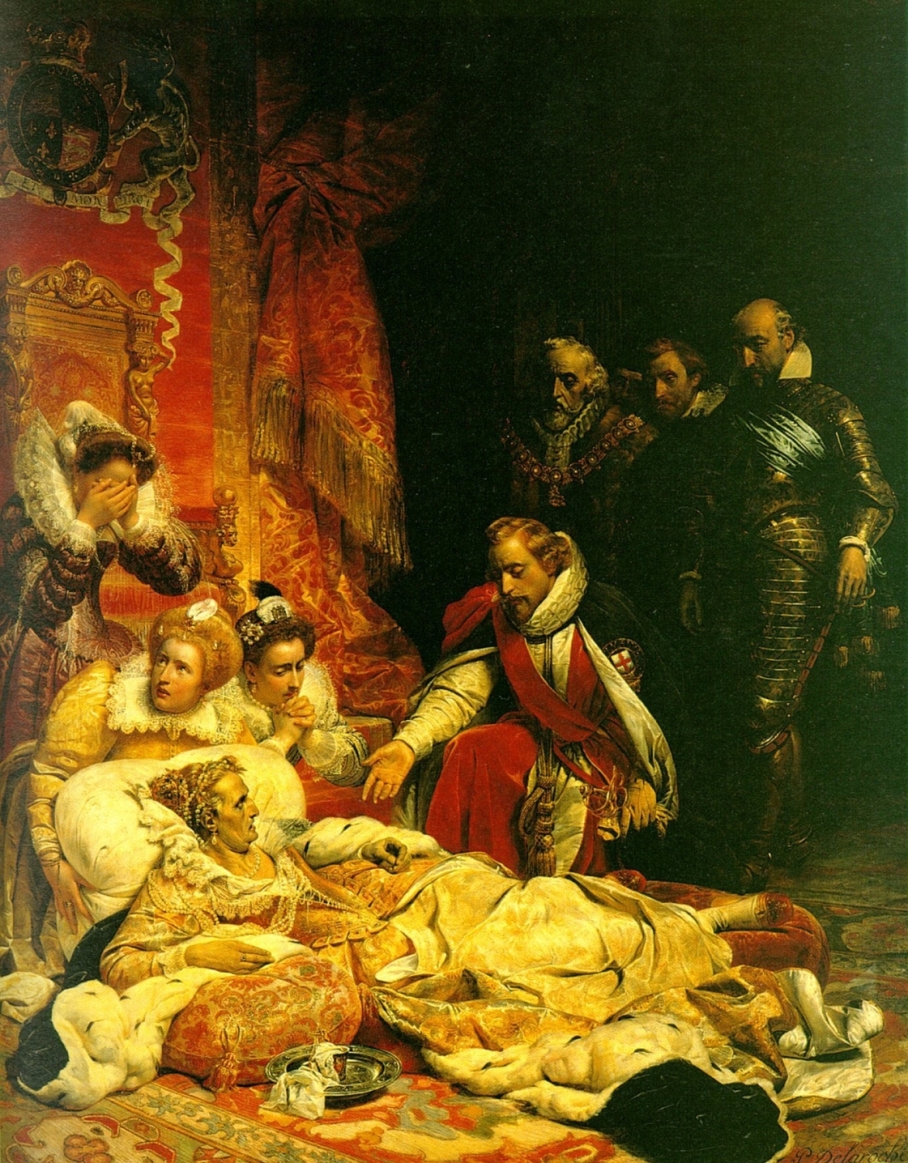
His work was not always historically accurate. Cromwell lifting the Coffin-lid and looking at the Body of Charles is an incident only to be excused by an improbable tradition. The King in the Guard-Room, with villainous roundhead soldiers blowing tobacco smoke in his patient face, is a libel on the Puritans. Queen Elizabeth dying on the Ground, like a she-dragon no one dares to touch, is sensational. The Execution of Lady Jane Grey is represented as taking place in a dungeon, which is badly inaccurate.

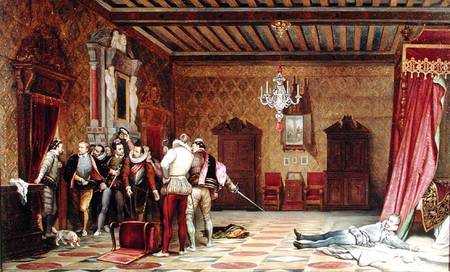
His 1835 Assassination of the duke de Guise at Blois is an exacting historical study was well a dramatic insight into human nature. Other important Delaroche works include The Princes in the Tower and the La Jeune Martyr (a young female martyr floating drowned in the Tiber).

Delaroche died on the 4th of November 1856.
Today this painting is located in the Wallace Collection, London.

Monday, 6 October 2008

The château de Thouars


As the château de Richelieu was demolished in the 1830's, many have tried to speculate what it was actually like.

One way is to create a computer model of the building and to look at it in a multi-media way. This has been done and the results can be seen in stereo at No.28 Grande Rue, Richelieu, or by looking at these web-sites that have video clips of the project. 

Another is to look at the very extensive contemporary graphic coverage of the buildings.

A third way is to go and look at buildings that still exist today that were built by the same building team.

Duke and Peer Henri de La Trémoille married Marie de La Tour d'Auvergne in 1619. Both aristocrats were initially Hugenots. As Richelieu rose to power and sought to reduce the power of widespread protestantism, the Duke revoked his calvinism and established himself afresh in Louis XIII's catholic court in Paris. (Was he following the political pragmatism of king Henri IV)? His wife however remained non-catholic and never went again to Court.

After a small improvement made to the mediaeval castle on the precipitous site in Thouars, the Duke and Duchess decided to entirely rebuild the castle, and used the king's (and Richelieu's) architect Jacques Lemercier and many members of the team from the recently completed Château de Richelieu. Thouars is about 50 kilometers to the west of Richelieu, in the department of Deux-Sèvres.

Thouars castle remains intact, having had many uses in the meantime; today being a secondary school and college. A restoration project has been underway for the last 15 years and still continues. The building, while of a different plan format as a consequence of its site, seems to be a close cousin of the building in Richelieu, although the style is much more severe as a result of the family's protestant inclinations. In comparison, the decoration is very subdued and extensive statuary, the result of Counter-Reformation Italianate influence emphasised by the Cardinal as part of his greater political project, almost entirely absent.

Wednesday, 24 September 2008

Cannelés bordelais


Not much to do with Richelieu really - but they are rather nice and the Abbé Henri has just perfected their preparation.  Cannelés (or if authentically from Bordeaux 'canelés bordelais') are small caramelised crunchy/gooey cakes that taste like vanilla ice cream but without the ice and without the cream.  Served with a crème anglaise or custard the are pretty nice to eat, so here is the recipe:

Step 1:
Cannalé moulds; individual moulds of tinned copper are very pretty, but don't be tempted by authenticity as getting the little blighters out when they are hot is a nghtmare.....so.....acquire a lovely new silicone 8-cannelé mould from a cooking shop.

Step 2:
Ingredients for 16 cannelés (ie two 8-cannelé moulds)
A 0.5 litre full milk
B 2 whole eggs
C 2 egg yolks
D 2-4 vanilla beans (fresher are better than dried out; not vanilla extract)
E 1.5 tablespoons dark 'Navy' rum
F 100 grams plain flour
G 200-250 grams caster sugar (more or less sweet to choice)
H 50 grams butter (reduce to 25 grams? - omit entirely?)

Step 3 
Preparation stage 1
1 Split the vanilla beans length-wise and scrape out the precious seeds
2 Add beans seeds and butter to the milk, bring to the boil and take off heat
3 Mix the flour, sugar, eggs and egg yolks in a bowl
4 Whisk at high speed for 3-5 minutes
5 Remove bean casings from the warm milk and transfer it gradually into the flour mix bowl
6 Add all the vanilla milk to the flour (with all the seeds but not the beans)
7 Whisk for 3-5 minutes as before
8 Cool the mix for 1 hour and then mix in the rum
9 Cool the mixture overnight in a fridge (or some say for 24 hours)

Step 4
Preparation stage 2 (next day)
1 Preheat the oven to 270 deg C (520 deg F); this is usually right at the maximum for most domestic ovens (slightly less for fan ovens)
2 Fill all the 8 moulds to 80%; don't leave any empty
3 BAKE at high temperature for 6-9 minutes (more or less caramelised outside), then
4 Reduce oven temperature to 180 deg C (350 deg F) and BAKE for at least another 1 hour (more or less gooey/cakey inside)
5 Cover with aluminium foil after 20 minutes of the hour
6 Take the mould out of the oven and invert onto a pie grid and let cool
7 After 10 minutes tap the canelés out from the silicone mould without damaging them

Step 5; Consumption
Two each. They are best after 1 hour; they can be frozen; they go rubbery if left out any real time.
Serve with real custard or crème anglaise (or maybe with real vanilla ice cream).

Would be nice with a bottle of Coteaux de Layon, or even a half bottle of Bonnezeaux


Monday, 22 September 2008

Bowled over by melons


The summer months of July and August are those of the orange fleshed cantaloupe melon, which is extensively farmed in Haut Poitou just next to Richelieu.  We were directed to go to Chapeau Melon - halfway between Richelieu and Loudun - and award them the family supply contract.  It is astonishing just how much melon one can happily eat on an August evening.  And the peak season prices are a delight.

p.s. un chapeau melon = a bowler hat; geddit!

Thursday, 18 September 2008

The façade of 14 Grande Rue


There are 28 mansions that line the Grande Rue, each originally built to the same design specification.  It is one of the largest collections of authentic seventeenth century houses in a single artistic composition in France. Until recently, several of these grand houses were in very poor condition, and finding the right use for such large houses has not been entirely easy.  They are too large for any individual's funds but too modest for a national monument. There is much earnest discussion as to appropriate use and whether 'any old use' that allows prompt restoration would be more relevant than patiently awaiting the perfect restoration context, perhaps ensuring complete and terminal dereliction.  No.14 was in truely awful condition. For a while it seemed to be in the sights of the Mairie, to act as the town's own museum mansion for visitors and tourists.  It was favoured as the particular site allows a rear public emergency exit to rue Henri Proust. But when the town chose No.28 Grande Rue instead, this building was reconceived as apartments for seniors, people in retirement (there are a lot of people en retraite in France as a consequence of the generous  provisions of the modèle sociale).

One of the wonderful aspects of buildings of this period is that they restore so well, and soon show the graceful quality of much French 17th century art.  So it is now with No.14.  There is a general policy to remove any commercial activity on the ground floor of these mansions and even if some retail is unavoidable by established rights, to restore the fenestration so that only the spandrels below the original window openings are altered. The incorporation of complete modern glassy retail façades is taboo. Commercial activity is to be encouraged in the two main squares, as was the intention of the original conception of designer Jacques Lemercier and the Cardinal Duc himself.

Wednesday, 17 September 2008

The château & town's water system (2) - in photographs

A former post written by chief architect of Les Monuments Historiques, Arnaud de Saint-Jouan, described the château and town's water supply system. Here are sylvan pictures of the various installations to match the very interesting and informative text. (Items references refer to the text).

Click here for the text.

The 17 century spring chamber at Bisseuil (item O)

The water aerator outside the castle (item P)


The town's old water tower fed from Bisseuil 


The Bollée hydraulic ram building (item J)

The old electricity generator building (item J)


The sluice from the ram and the powerstation (item G)


The sluice flowing past the hydraulic ram (item G)


The current supply canal in its 19 century relocation (item D)


The grand canal looking south towards the original 17 century feeder canal and sluices location (item E), now largely blocked and silted up

The sad location of the derelict embarquadère on the grand canal, demolished in 2007 (item L)


The inaccessible location of the reservoir, within the walled hunting park with the wild boar (item M)


The view of the grand canal's exit sluices from the main park (item F)


The main exit sluices (item F)

The sluice's stonework abutments (item F)


The final overflow pond before the entry to the town's moat, now partially planted with poplars (item I)

Tuesday, 16 September 2008

Where the money goes on a baguette


I found this interesting picture on another blog.  I'll never eat another baguette without thinking about profit and loss!  I should date this picture as September '08.  What  a lot of salaries, n'est-ce pas?  Is this the effect of crazy 'social costs'?


Fête de Locomotion 2008


The Richelieu Festival of Locomotion is held in the domainal park of the Château of Richelieu every other year.  This year it took place on the weekend of the 6 and 7 September 2008.
Saturday is really a day of set up, but in the afternoon there was an auction of historic and sporty cars run by auctioneers from Chinon.  This year the sale included the world's largest collection of Velos Solex, the front-wheel power-assisted bicycles that seem associated with berets, onions, Gaulloises and other iconic clichés of la douce France.  Now they are a rarity as everybody drives cars.  
Twenty or so ancient or sporty cars were sold off to an expectant audience, and bargains were to be had.  How much would you pay for a classic Citroën H van in rare pick-up format? - believe me, the lucky purchaser was delighted at what he paid.  The next day the main event started with a gracious tour of the locality at the speed that can be achieved by 1926 Citroën saloons, which stopped off at a château behind Fay-la-Vineuse for a vin d'honneur and a session admiring the collection of cars.  The long line of cars was protected by WW2 Willys jeeps marshalling the 2008 traffic; the military vehicles complete with very pretty girls of the Free French forces riding shotgun with the Yankee liberators. Followed of course by déjeuner together under the trees of the park.
Well done to the Amateurs d'Utilitaires de la Vallée de la Loire for the whole event. 
(p.s. vallée n. f. is a valley, so surely de la vallée rather than de le vallée?  
Quelle horreur!!)

thanks to Susie for the pictures - Abbé Henri Proust's old Box Brownie is acting a bit dickie at the moment...

Friday, 12 September 2008

The new Richelieu stamp (2)


Thank you Jean et Caroline for getting us an immaculate first day cover (5th August 2008) of the 0.55 cent stamp depicting the Duc-Cardinal and the Porte de Châtellerault of the town of Richelieu.

This follows an earlier post in this  site, warning of the issue by La Poste.

Thursday, 11 September 2008

Back in the saddle

Abbé Henri Proust, who writes most of these blog posts, has finally arrived back at his presbytery computer, so the stream of Éminence Rouge blog posts, all about the gorgeous little town of Richelieu, can now resume after les vacances.

Welcome back M. l'Abbé!