The topics of this blog are Armand-Jean du Plessis, Cardinal Duke of Richelieu, and the IDEAL CITY built on his command next to his magnificent CHÂTEAU on the borders of Touraine, Anjou and Poitou, in France.

Showing posts with label Gardens. Show all posts

Saturday, 12 August 2017

Big trees fall in the park

a new clearing in the parc

the foresters tidy up the huge fallen trees

how old, dendochronologists?

the 'electro mill' race, a bit encumbered...

a branch still in the roof of the Bollée ram building

another fallen tree on the grand canal

Wednesday, 9 August 2017

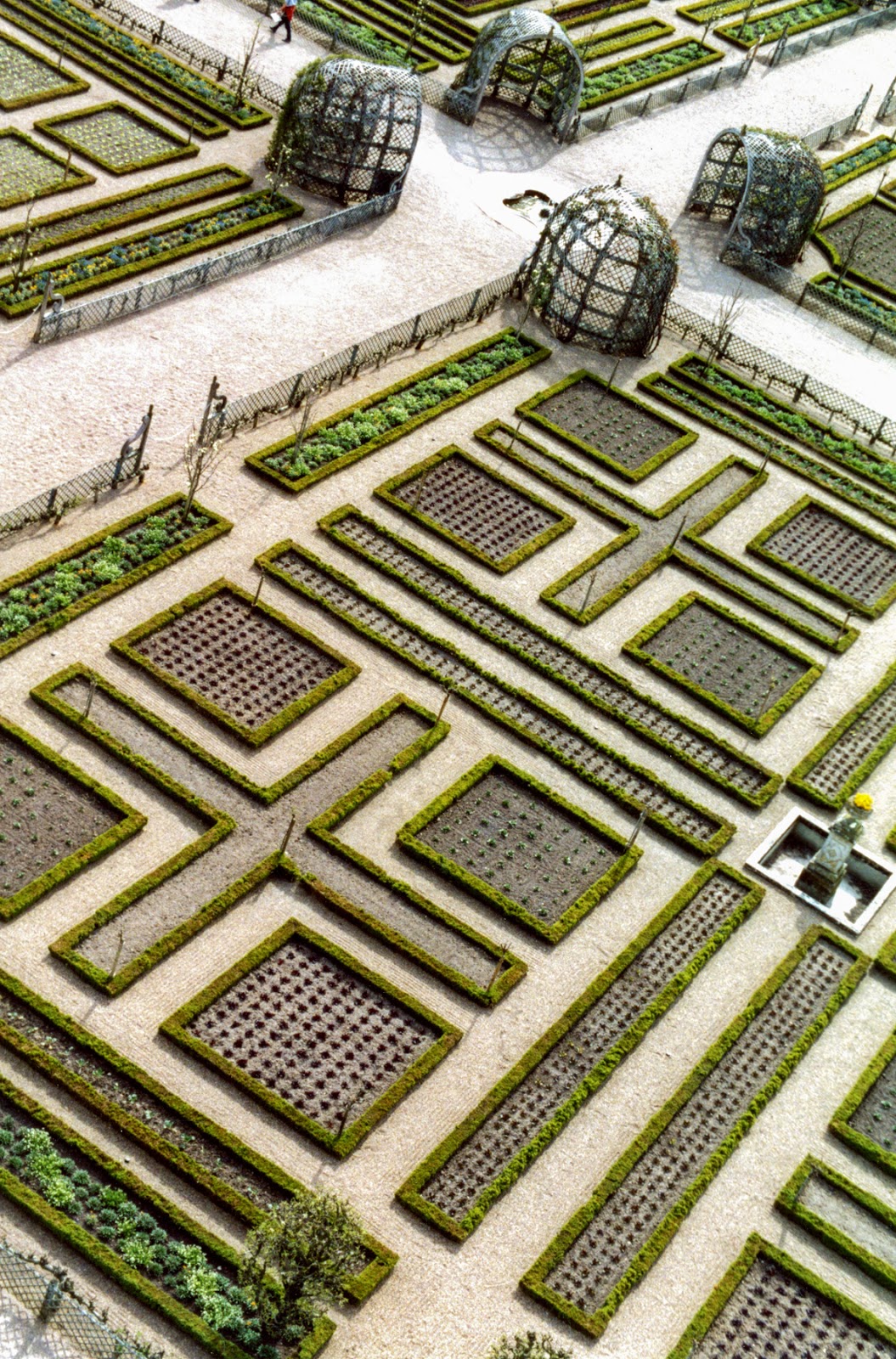
The new gardens at the Château de Chambord

the view at the garden door
The gardens in front of this famous Loire château have been reconstructed. They were opened to the public only on 20 March 2017.  They counter-balance the overbearing scale of the old building as can be seen in these pictures, and help us imagine the leisure of the occupants in their day. The gardens are truely VAST in scale. So are the numbers of trees and plants.

Worth a visit.
Imagine how impressive were the similar gardens of the now-absent château de Richelieu

the Château de Chambord

from the new garden


***

Tuesday, 19 May 2015

Pollarding the lime trees


Look! no cars - and all the trees have had a haircut….

"a short back, sides and top please, Sir".

the restored halle roof behind

Tuesday, 18 March 2014

Wednesday, 29 June 2011

Abbé Henri Proust's garden inspiration

...click on the picture to see the details within...
"What do you think of my new raised beds, Beatrice?" by Pieter Van Avont (1600-1652)


***

Wednesday, 8 June 2011

Richelieu - 'Ville fleurie'

This year the town council of Richelieu has taken upon itself to smarten the town up a bit by planting trees and shrubs in the straight and rather minérale streets of the 17th century 'grid' town.

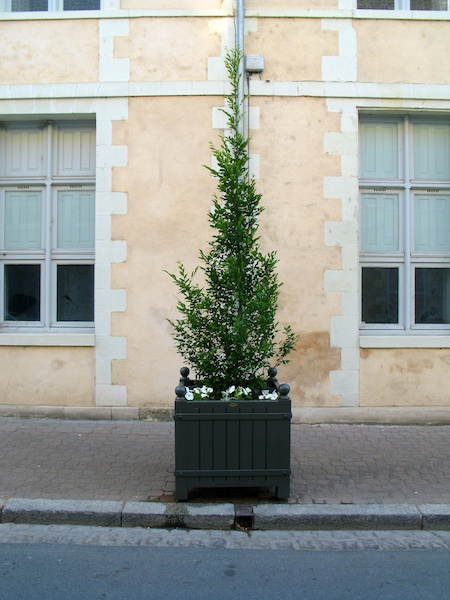
Firstly, and most formally, they have installed caisses de Versailles on the boundary line of each successive hôtel particilier - mansion - on the Grande Rue.  In each caisse is planted a tapered hornbeam (carpinus betulus fastigiata), about three meters high.  Over successive seasons these will be pleached to be trim tall pyramids.  Such planting is contentious with Bâtiments de France as some think that such 'softenings' are inappropriate and out of style for the 17th century period.  This seems (to H. Proust) to be a bit strict as a point of view, as the little town has of course lived through subsequent centuries and amassed all sorts of later influences (cars, or neon pharmacy signs for example!) that change the perceived character and 'authenticity' of the town.

The Grande Rue with its new caisses de Versailles
Despite these stylistic worries, the 24 planters have now been installed, and the effect is quite striking in such a dogmatically axial street.

a new hornbeam

...and another...

...floral planting in each tub...
Secondly, smaller matching planters have been installed on the church steps and elsewhere on the place du Marché.  While there were planters in front of the church, the new ones soften the rather naked facade.  The main trees that encircle the new square layout were omitted in front of the church, allegedly to allow large church services and particularly funerals.  A mistake in HP's view.  So these new church planters improve matters, and could be moved if circumstances require.

the church steps with new planters
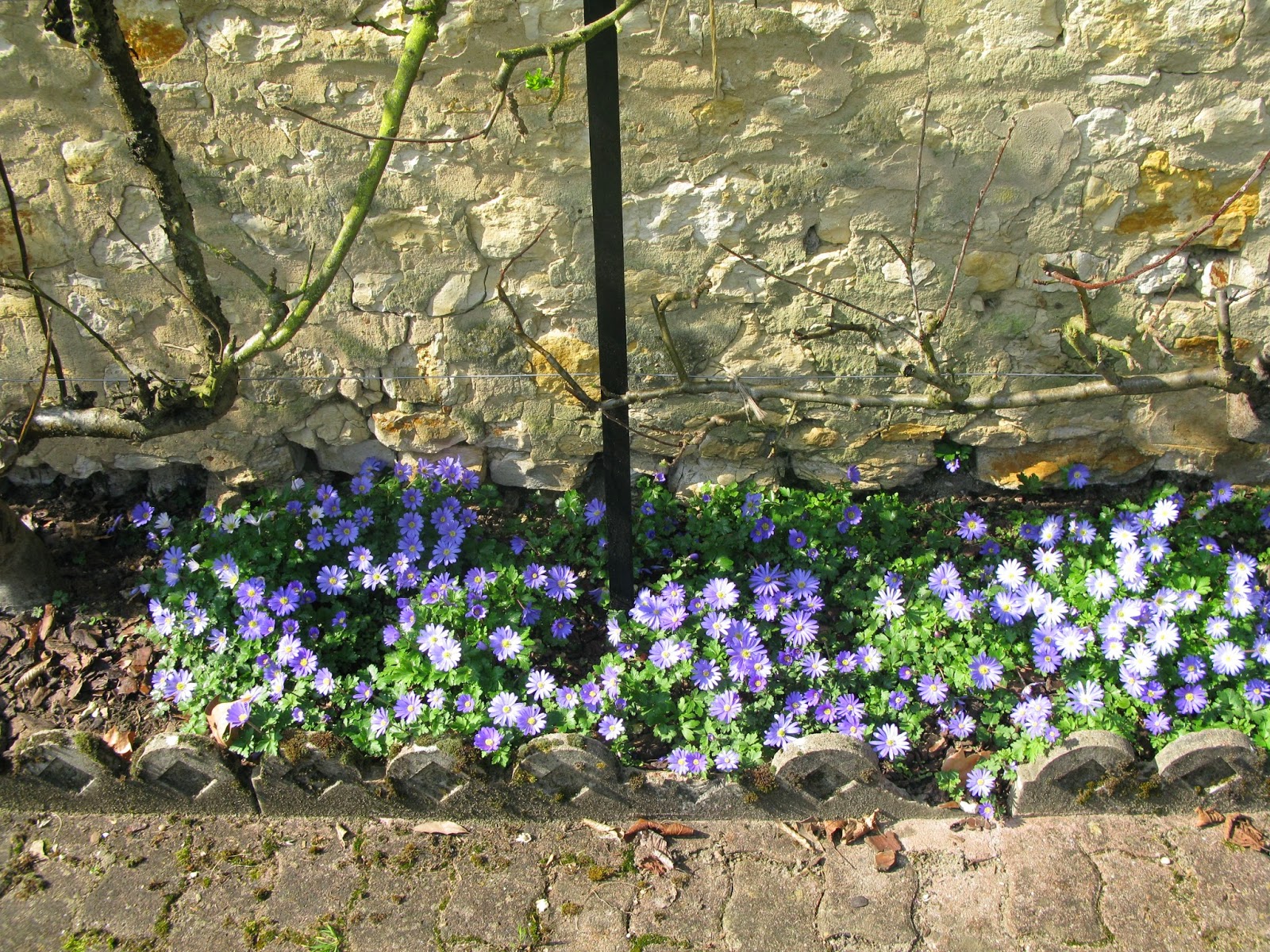
Thirdly, property owners not located on the Grand Rue were asked if they would like to have a plant installed in the concrete pavement, adjacent to their own house's façade.  This offer as been taken up in quite a few locations.  While the caisses will be watered by the municipal bowser, individuals will have to water their own new plantings.

new pavement plantings


A older planting installed in the same way but now fully grown up, looks like this.

on rue Traversière

Monday, 17 May 2010

tempête Xynthia

This raging storm passed through Richelieu on the 28 February 2010. In the domainal parc of the château de Richelieu the tall, tall plane trees took the brunt of the wind. Most of them survived and live on but an occasional tree in the lofty avenues was shattered in the storm's fury.

The foresters quite quickly reduced the fallen into nice stacks of split logs. The price of firewood slumped, especially if you need plane tree wood.

The tempest past, the ethereal calm of the parc is now re-established and the canals mirror the plentiful surviving trees. The newly restored handrails on the canals' bridges in 'permitted' oxbood paint now seem to have weathered in well. And shrunk a bit.

Saturday, 30 May 2009

Moat gardens

The cité ideale was originally completely surrounded by walls and a continuous wide moat. The little river Mable was diverted to feed the moat and protect the town walls.  Since the foundation of the town in the 1640s, many generations have hoped to benefit from this moat in various ways, as its ownership was common and, once the cardinal himself was buried, was the question; is there anyone who would object 'if I borrowed a bit'?
Holes were cut in the town walls for windows.  Original agricultural sheds, built against the town wall's interior, magically expanded into the moat and developed windows too.  The wide watery moat was reduced to a narrow trickle, and the  dry moat almost entirely backfilled.  So convenient to have a close (and free) water supply for one's vegetable garden in the summer.

Bâtiments de France want to row back; to recreate the majesty of the original concept, and around the Chinon gate, on the town's north face, this majesty can be seen, as the moat area is owned and controlled by the town itself.

But the passion for gardening, together with the French passion for 'something for nothing' has resulted in some rather fine furtive kitchen gardens.  While some have lazy or absentee gardeners, some, such as the two below, are as 'trim as a trivet'!

see Richelieu Locations on the right for an aerial view


Tuesday, 19 May 2009

three musketeers in a boat


One can rent a rowing boat for 7€ an hour and have a water-borne luncheon on the parc's canals. The present jetty is located near to the public entrance of the parc close to la place du Cardinal, just south of the town.

Tuesday, 10 March 2009

The problems of geometric order


Thr parc de Richelieu comprises one of the most extravagant garden designs of its day. The 17th century new château in the form of a 'country house' - unprotected and without defensive walls - was replacing the ancient fighting castles which had still been important in the endless civil guerres de religion of the French sixteenth century.

The manner of the landscapes that flanked these new opulent large-windowed neo-classical Wonderlands was drawn from contemporary Italian projects (the Villa Lante for example) that were seen as the correct architectural inspiration; part of the general strategic counter-reformation 'project' run from the Vatican. These villa gardens had in turn had been conceived from classical Roman precedent, filtered by 16th century architects such as Vignola and Palladio.

The new designs saw much allegoric symbolism in strict geometric layouts, often reinforced by avenues and allées of trees.

As the years passed by, the country houses of Whig England in particular would initiate a garden of the picturesque - called le jardin anglais in France - typified by the famous gardens of 'Capability' Brown and Humphrey Repton.  These were neo-naturalistic gardens based on a different neo-classical allusion, the pictures of Claude Lorraine, that portrayed a free 'natural' landscape with ruins and peasant swains.

One of the problems of the French classical garden of avenues is that so trying and tedious thing, the WEATHER. The Touraine winter storms of February 2009 were savage, if slightly less so than those in Aquitaine to the south-west. But the avenues of the parc de Richelieu suffered. Many of the avenue's trees were up-ended, and the gardeners had a major effort in reducing these formerly healthy trees to log. They will of course be re-planted, once the old root has been extracted (the line must be maintained, of course), but in the meanwhile the folly and conceit of avenue planting is only too obvious, with horrible gaps giving a lie to the frail ambitions of a layout of strict geometry. 

Had the designer laid it all out in the manner of a later irregular jardin anglais, few would find the storm's inheritance objectionable.

But now we, les richelais, will have to wait a long time till the 'gap teeth' of the parc's avenues are re-filled by major arboreal root-canal work.