The topics of this blog are Armand-Jean du Plessis, Cardinal Duke of Richelieu, and the IDEAL CITY built on his command next to his magnificent CHÂTEAU on the borders of Touraine, Anjou and Poitou, in France.

Showing posts with label Busts. Show all posts

Thursday, 19 November 2020

The statue at the entrance to the parc & the restored Dôme in autumn.

Statue of the Cardinal-Duc by Ramey, formerly on the Pont Louis XVI in Paris

 
An autumnal view of the 'Dôme'; last remnant of the former château de Richelieu.

***

Monday, 25 February 2013

Pont Louis XVI and the statue of the cardinal

The widened bridge 'de la Concorde' in Paris today
L'architecte Jean-Rodolphe Perronet, qui a créé en 1775 avec Daniel-Charles Trudaine l'École royale des ponts et chaussées (aujourd'hui École nationale des ponts et chaussées), est chargé en 1787 de la construction de ce pont en arc.

Ce pont était en projet depuis 1725, lors de la construction de la place Louis XV (aujourd'hui place de la Concorde), pour remplacer le bac qui assurait alors la traversée à cet endroit.
Assurant la construction en pleine tourmente révolutionnaire, il utilise pour la maçonnerie des pierres de taille provenant de la démolition de la Bastille, prise d'assaut le 14 juillet 1789. La construction sera terminée en 1791.

En 1810, Napoléon Bonaparte y fit placer des statues en l'honneur de huit généraux morts au champ d'honneur pendant les campagnes du Premier Empire.


The architect Jean-Rodolphe Perronet, who in 1775 created (with Daniel Charles Trudaine) the "Royal School of Bridges and Roads" (now the "National School of Bridges and Roads") was responsible in 1787 for the design and construction of the new arched bridge.

A bridge had been planned since 1725, during the construction of the Place Louis XV (now the Place de la Concorde), replacing a former ferry crossing, then at this location.
Ensuring that the construction continued during revolutionary turmoil, Perronet used the stones and masonry from the demolition of the fortress of the Bastille, which had been stormed on 14 July 1789. Construction of the bridge was completed in 1791.

In 1810, Napoleon Bonaparte placed on it statues in honor of eight Generals killed in battle during the campaigns of the First Empire.


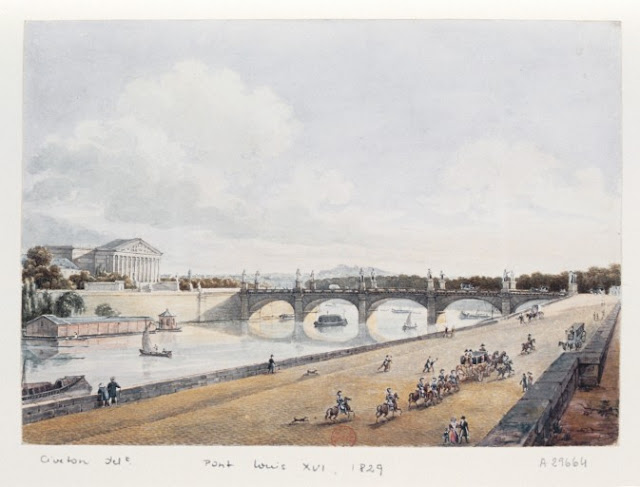
the pont Louis XVI on 1830, with the 12 colossal statues
the pont Louis XVI in 1829, more-or-less  the date of the statue by Claude Ramey père
that is now located in the town of Richelieu in Touraine

À la Restauration, on les remplaça par un ensemble de douze statues monumentales en marbre blanc de quatre grands ministres (Colbert, Richelieu, Suger, Sully), quatre militaires (Bayard, Condé, Du Guesclin, Turenne) et quatre marins (Duguay-Trouin, Duquesne, Suffren, Tourville). Mais cet ensemble est trop lourd pour le pont, et Louis-Philippe Ier fait enlever ces statues pour les transférer à Versailles.


At the Restoration, these eight were replaced by a set of twelve monumental white marble statues of four Ministers (Colbert, Richelieu, Suger, Sully), four soldiers (Bayard, Condé, Du Guesclin, Turenne) and four sailors (Duguay-Trouin, Duquesne, Suffren, Tourville). But all this was too heavy a load for the bridge's structure, and Louis-Philippe I removed the statues and transferred them to Versailles.

In 1932 the monumental statue of the cardinal duc de Richelieu was erected in his eponymous town in Poitou.


English description of the statue of Ramey père of 1830

These three pages are from the following book;
"Museum of painting and sculpture, or, Collection of the principal pictures, statues and bas-reliefs in the public and private galleries of Europe."
Author:
Etienne Achille Réveil (drawings); Jean Duchesne (text)
Publisher:
London, Bossange; Paris, Audot
1828


page 222 of "the Museum of painting and sculpture...."
The inauguration of the statue in Richelieu town on 17 July 1932

CLICK HERE FOR THE SCULPTURE TODAY

the signature at the statue's base

the statues in place

Perronet's original concept drawing for the pont Louis XVI

The statue itself, now in 37120 Richelieu


***

Sunday, 19 August 2012

She scrubs up well

 BEFORE - a rusty Virgin...
The niche located at the north end of rue Henri Proust, on rue de Jarry, contains a statue of Mary, who is celebrated here as the result of successful prayers of inter-muros parishioners of the Richelieu church, itself dedicated to the Virgin.  
These prayers resulted in the saving of the town of Richelieu from an epidemic of Cholera in the 19th century.
Now re-furbished and de-rusted. 


***
'It's him wot dun it' - Cyr, that is,
just in time for the Assumption of 14 August 2012
Thanks Cyr - she is lovely now; as befits the Virgin Mary!
***

Wednesday, 31 August 2011

More details of the statue of the cardinal...

With this second post on the subject, we take a bit more time with the statue of the cardinal duc, Armand-Jean du Plessis, the founder of so many French activities and organisations that have endured to our day.  The statue is located on the place that sits between his château's domainal parc to the south and his model town to the north.
He poses giving a cardinal's blessing to the viewer with his right hand, while holding the document of foundation of the Académie Française (dated as 1635) in his left.

the all-seeing, all-knowing statesman

The statue has several 'credits' attached to it.
the sculptor's credit 1828
the relocation of the statue in 1932

the Second Regiment of the Marines

dedications from the Second Regiment of the Marines


  • The sculptor - C(laude) Ramey, père - Dijon, dated 1828
  • The inauguration of the statue in Richelieu 17 July 1932, probably as part of the bequest of the domainal parc to the Sorbonne (of which Armand-Jean was the first rector, and in whose chapel he rests to this day) by the eigth and last duke.  It had formerly been located on the Pont Neuf of Henri IV in Paris for the period 1828-1932.
  • Two plaques of the Second Regiment of the Marines to their first Chef de Corps, one from 1932(?) and the other from the Lieutenants of the Second of the Marine, dated 9 December 1995 to their founding 'father'.  The old strategist and pupil of Pluvinel's equestreian & military academy is not forgotten!
the cardinal up closer

the foundation of the Academie Française

***


Friday, 1 July 2011

The cardinal duc scrubs up well...

the statue of the cardinal duc on the place Cardinal, in front of the porte de Châtellerault

before...
after...

This newly-cleaned statue stands between the cité idéale and the domainal parc and château.
It was carved in 1828 by sculptor Claude Ramey (29 Oct 1754 - 4 June 1838)
and formerly located on the Pont de la Concorde in Paris.
Now maintained by the French 2nd Regiment of Marines
 of whom A-J d P was
and is now a patron.


more on this statue HERE

many thanks to
http://inandaroundbraye.blogspot.com/

***

Sunday, 21 June 2009

Tuesday, 17 March 2009

les bustes

What does a power behind the throne do for fun? 

In le cardinal duc de Richelieu's case, the bling activity of A-list celebs of the day was the collection of classical statuary and artefacts.  This fitted into the renascent classical culture that was part of many strands of Early Modern political thought; the Italian Renaissance itself, the rediscovery of all sorts of Roman relics, the study of Roman history as a guide to statecraft, the Roman-led counter-reformation, the general aping of all things Italian, Roman - ancient or modern - and the influence of the trixy queen of Henri IV, Florentine Marie de Medici, Richelieu's own first 'boss'.

If one reads Marie Pierre Terrien's book on the town and its history, page after page describes the collection of statuary that was assembled in the château by the cardinal, by his creatures and agents abroad.  Even the world-famous 'Dying Slave' of Michelangelo.  The Louvre groans with busts and statues from Richelieu's collection to this day.

Richelieu identified himself wih Hercules - Herakles in Greek - he of 'the twelve labours'.  So statues of his own particular hero were very big deal.  A famous statue of Hercules had been found at the baths of Caraculla in 1546 - the 'Farnese Hercules' - and this was the ultra-cool bling item of the Italian art world of the day.


So what can be seen of this obsession today in his cité idéale?

Four busts can be seen mounted (garotted more like!) on the walls of the the the courtyard of the hôtel particulier of the 'sénéschal' - the patron's representative - of the town.  17 Grande Rue.


And in the Dome in the park, the last fragment of the original château, a plaster cast of the Dying Slave.  The original is (of course) in Paris.

All this has made me look at all this here-to-fore seemingly kitsch stuff with new eyes - I begin to long to start a new collection myself, ponder the location of each imagined bust and statue, consider the right height of the plinth, wonder which deity or hero might have the right allegorical resonance etc.........


the Farnese Hercules; a 17th century engraving of his rear, and a modern bust copy of the noble head.  
A gilded copy of the full-size statue was used by the celebrated gardener André Le Notre at the garden of Vaux-le-Vicomte for the banker Nicholas Fouquet.

Tuesday, 14 October 2008

Philippe de Champaigne's house in Paris - 1645


Philippe de Champaigne's house at 11 Quai de Bourbon, Ile Saint Louis, Paris. Champaigne was the favourite painter of the cardinal de Richelieu and the author of the many official portraits and the famous triple portrait sent to Bernini as a guide to carve the bust of the cardinal while the artist remained in Rome.

Wednesday, 14 May 2008

The Cardinal-Duke must have missed this bust in his hunt for statuary for his château.

Bust of Julius Caesar found in Rhone - 13 May 2008

A life-sized bust of Julius Caesar, thought to date back to 46 BC, has been found in the River Rhone near Arles.
The culture minister Christine Albanel said the bust was 'exceptional' and that it was believed to be the oldest representation of the Roman emperor.

Other finds recovered by divers at the site include a marble statue of Neptune, dated to the third century, as well as two smaller, bronze statues, and more research of the area is planned for this summer.

Tuesday, 3 July 2007

A tale of paintings, statues and busts


In 1640 Richelieu decided to commission a full height portrait statue from the Roman artist Gian Lorenzo Bernini (1598-1680). While ordinary high churchmen were normally painted and sculpted only at bust length, First Minister Cardinal Duke Richelieu normally had himself painted full-length as a symbol of his Power and Glory as statesman.The negotiations were entrusted to Jules Mazarin, then a trusted agent of the Cardinal (and his subsequent successor), and to Marshal d' Estrée, French ambassador to Rome. They not only had to obtain the assent of the artist himself, but also of the artist's
patrons, Cardinal Barberini and Pope Urbano VIII. Following disagreement on the part of the Pope to the plan for a full-length statue, Bernini was required to reduce the proposal to a shoulder-length bust. The celebrated Roman artist began the work in the November of 1640 and completed it in January of the following year 1641. In August the bust was taken back to Paris, where they discovered that the statue was not to be full-length as ordered. Although Mazarin fullsomely thanked Cardinal Barberini, in reality the sculpture did not please, as, despite detailed care and efforts by the artist, the face did not catch very well the true features of the Cardinal. This situation can be deduced from the later demands from the Cardinal for the preparation of another statue by the Parisian sculptor Jean Warin.

The principal court painter for Richelieu was the Paris resident Flemish master from Bruxelles, Philippe de Champaigne (1602-1674). It was he who produced the several full-length official portraits of the Cardinal, often used as diplomatic gifts; one in the Louvre (this one), and another very similar in the National Gallery in London. He was asked to produce a triple-portrait of the Cardinal to be sent to Bernini as an accurate-to-life representation of the subject of the commissioned statue as Richelieu and Bernini had never met. This stunning picture, now also in the National Gallery London is the best portrait of the French Statesman and has, behind the frame, a hand-wriiten note from Champaigne that says, artist-to-artist (and with some modesty), that the right-hand profile was the closest to life. A few years earlier van Dyke had done exactly the same type of portrait for King Charles I. These triple-portraits seem to allow one to see the individual behind the famous icon, both men late in life and not looking very well. Richelieu, often an invalid, died a couple of years later.