The topics of this blog are Armand-Jean du Plessis, Cardinal Duke of Richelieu, and the IDEAL CITY built on his command next to his magnificent CHÂTEAU on the borders of Touraine, Anjou and Poitou, in France.

Showing posts with label Heine. Show all posts

Thursday, 12 April 2018

The 'Dome' in the parc of Richelieu

The 'dome' is the last remaining part of the 'avant cour' of the château de Richelieu. It was a large former manège - or horse riding hall - that led through to the exercising yard behind.  Until recently the building was being used as a venue for talks and concerts, located at a comfortable and pretty walk from the cité idéale itself. The original building had been considerably changed in the 19th century as this dome was formerly sandwiched between other modules of the courtyard perimeter, then demolished. Under the management of the Heine family, solid abutments were added to the four corners to make the building stable, and the east and west walls were created and elevated over the 'stumps' of the former flanking pavilions.  It was put back in shape as best could be, very much in the optimistic manner of the ebullient 19th century taste.

The roof in particular has become unstable since the days of the Heine family and now the whole building is currently under restoration.  This year, the August music festival will be obliged to relocate to other premises.

Pictures below show the current state of the works.


***

Tuesday, 21 March 2017

Clearing the carp pond

The parc of the cardinal duc de Richelieu was reborn in the nineteenth century when the Heine family reassembled the by-then fragmented post-revolutionary portions of the ancient parc 'probably' to the designs of the well-known Parisian landscape architects, the Buhler Brothers. This firm had assumed a role of national importance as, with the invention of the railway system, they could now ply their aristocratic trade over the whole of geographic France. The parc and estate were reconstituted as part of the dowry gift to the then duke of Richelieu, who had taken the hand of the beautiful and rich banker's daughter, Alice Heine.

(Another landed estate re-designed by the Buhlers is located at Azay le Ferron, not too far away from Richelieu.) 

In the location of the historic castle's basse cour and avant cour - the outer and inner arrival courtyards - they built a large but shallow carp pond to act as a reflecting pool on the layout's main axis.

It is surrounded by the large allées of plane trees, now grown to full height.  These huge trees dump their autumn leaves into the pond each year, and every decade or so the parc's stewards have to clear all the rotting sludge out. Quite a task! The pond is finally restocked with fish.

Below a few pictures of the task half completed, with pressure hoses cleaning up the central fountain.


Where can we find authenication of the designers of the Parc de Richelieu?
SUGGESTIONS PLEASE!

"Eugène (1822-1907) and Denis Bühler (1811-1890), were born in Clamart into a Protestant family. At their father’s death, Denis was obliged to take over the family business and became a nursery gardener. Eugène studies garden landscapes at the Versailles horticultural school until they both settle in Paris in order to design parks and gardens.

1842 Their first project at Kernevez in Britany, was followed by many others in the area such as the parks of the châteaux of Combourg, Bonnefontaine, Briantais, then Oberthür, Bois-Cornillé… They restructure the Gardens of la Tête d’Or in Lyon in 1857, of the Domaine de la Grenade à Saint Selve in 1859, of the Château of Courson, Essonne in1860, of Thabor in Rennes in 1868 and the gardens of Prébendes d’Oé in Tours in 1872, followed by the college St François de Sales in Evreux in 1883. 

During the end of the XIXth century, the Bühlers start their projects in the south of France and specifically in the Hérault region in Languedoc.

They design the parks of : the du Domaine of Verchant, the Château of Raissac, Libouriac and the ''Plateau des Poètes'' in Béziers around 1880. The gardens of the Château de Brochon, Côte d’Or, in 1885, is followed by la Sallière in 1886 and the ''Parc Bordelais'' in Bordeaux… The Bühler brothers make a particular statement by planting rare and exotic species in their landscaped gardens. 

Their conception of a garden:
The alleys or paths of their gardens were designed in harmonious curves and lines, essential to its general beauty. They studied the natural irregularities of the ground which remained the frame of their garden landscape. Trees, flowers, bushes then become the important elements of their style. Rare species are planted on the lawns to be seen by all. Trees are planted according to their shapes and colours to maximise perspectives. Bushes and beds of flowers, well chosen and local to the area, are planted near the house. The garden seems natural, but the influence of designers is visible. Shrubs are designed in elliptic shapes. Water is an essential element of the garden’s harmonious design with waterfalls, ponds, rivers and fountains… all appearing in their most natural way."

***

Monday, 27 April 2015

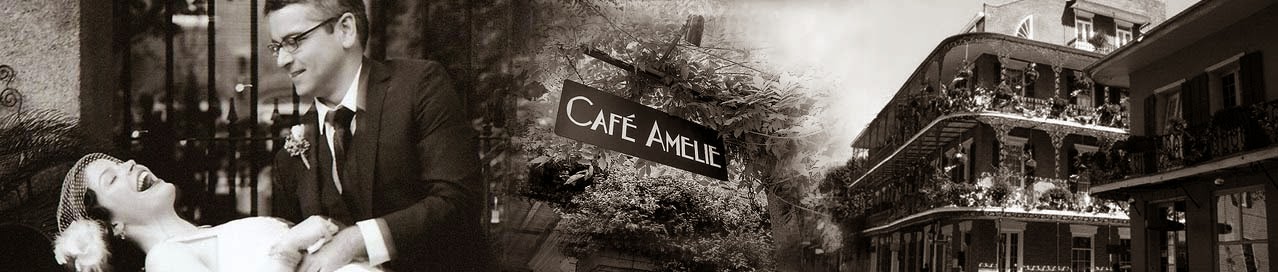
Café Amélie and the 7th Duchess of Richelieu

Café Amélie, 900 Royal Street, New Orleans, USA


A chum of the old Abbé HP has had the opportunity to visit the city of New Orleans.

So what is the connection with the cité idéale, here in Poitou?

The 7th duke of Richelieu (and Fronsac) married the American heiress, Alice Heine. She gave a son and a daughter to this older husband in their five short years of marriage. She herself was the daughter of Michel Heine, head of the Berlin/Paris/New Orleans bankers Heine & Cie. Michel reconstituted the ducal domaine around the château de Richelieu as a flamboyant wedding gift, after the property's fragmentation following the defeat of the little Corsican at Waterloo in 1815.  The 5th Duke had escaped from the 1789 Revolution by going to Russia, and the family estate had been sold and divided.

The park one sees today in Richelieu is really the result of this spectacular gift, re-designed by the well known 19th century landscape designers, the Buehler Brothers.

This rich and glamourous belle of New Orleans was the daughter of Michel and Amélie Miltenburger, a daughter of a prosperous New Orleans family of architects. They had a string of houses on Rue Royale in the French Quarter centered on street number 900.

Today this connection with France and Monaco is well remembered in this partly Francophone city.  The Milterburger houses are still there, redolent of the grand mansions of New Orleans, and Alice's birth house is now a popular restaurant called Café Amélie, named after Alice's mother.


Abbé Henri's souvenir tee-shirt; 25$!


Wednesday, 16 October 2013

The Heine family and its Richelieu generations


The German romantic poet Heinrich Heine was the cousin of the banker Michel Heine
  • Isaac HEINE est né vers 1763 à Hanovre (D). Il est banquier et négociant à Bordeaux. Il épouse Merian MICHEL dite Jeanne. Isaac décède le 16.10.1828 à Bordeaux.
    • Son 1 fils: Michel HEINE est né le 19.04.1819 à Bordeaux (33). A La Nouvelle-Orléans (USA), il épouse Marie Amélie MILTENBERG, née le 25.05.1832[1] à La Nouvelle-Orléans (USA). Après un long séjour aux Etats-Unis, Michel revient en France et fonde les Maisons Ouvrières. Il est alors domicilié au 21 Avenue Hoche Paris 8ème. Michel est banquier pour A. et M. Heine et Régent de la Banque de France XIIIème Siège du 30.01.1890 à sa mort. Michel décède le 10.11.1904 à Paris 8ème, et Marie Amélie le 12.05.1915 à Richelieu (37). Ils y sont inhumés dans le caveau familial.
    • Sa 1 fille: Marie Alice HEINE est née le 10.02.1858 à La Nouvelle-Orléans (USA). Les 25 et 27.02.1875, à Paris 8ème, elle épouse Marie Odet Richard Armand CHAPELLE de JUMILHAC, 7ième Duc de RICHELIEU, né le 15.11.1847 à Paris 1er ancien, fils d'Armand Henri Marie Marcel CHAPELLE de JUMILHAC, 6ième Duc de RICHELIEU. Armand décède lors d'un voyage le 28.06.1880 à Athènes (GR). Il est inhumé dans le caveau des RICHELIEU à la Sorbonne à Paris. En secondes noces, Alice épouse le 30.10.1889 à Paris 8ème, ALBERT Ier, Prince Souverain de Monaco, né le 13.11.1848 à Monaco. ALBERT Ier décède le 26.06.1822 et Alice le 22.12.1925 à Paris 8ème. Alice est inhumée au cimetière du Père-Lachaise, à Paris.
    • Son 3 fils: Isaac Georges HEINE est né le 26.10.1861 à Paris 8ème. Il est banquier pour la Maison Heine et Cie., 22 rue Bergère Paris 9ème, maison qui succède à la Banque Fould, et Régent de la Banque de France VIIème Siège du 29.01.1914 à son décès. Georges décède le 03.06.1928 au Château de Richelieu, et les obsèques ont lieu le 08.06.1928, à 10h, en l'Eglise de Richelieu (37) et il est inhumé dans le caveau familial à Richelieu (37).
      • Son 1 petit fils: Robert HEINE est né le 20.03.1919 à Paris. Sa mère est, selon le journal "Aux écoutes" du 25.08.1928, "une grande dame de l'aristocratie parisienne".

Wednesday, 27 February 2013

A post about the eighth duc de Richelieu...wot i found...

the eighth duc
The eighth DUC DE RICHELIEU is ENJOYING NEW YORK’S SOCIAL SEASON.
The descendant of an illustrious family, he is spending the winter here, and is related to prominent American Families. His mother, Alice Heine was born in New Orleans.
By A Veteran Diplomat
The New York TimesJanuary 15, 1911
"France has several Dukes, bearers of historic titles and of illustrious names, who are half American, through their mothers. Among them is Jean Armand Chapelle de Jumilhac de Richelieu, (8th and last)  Duc de Richelieu, Duc de Fronsac, Marquis de Jumilhac, who is now spending the winter in New York, and taking an active part in the gayeties of its season.
Alice, 7th Duchesse de Richelieu
His mother, born at New Orleans, as the daughter of Michel Heine, a leading banker there, enjoys the distinction of being the only American woman who has ever attained sovereign rank in the Old World, and who has figured at the Courts of Europe, not among the mere nobility, but among the crowned heads. She attained possession of her place on a throne through her second marriage to the reigning Prince of Monaco, and although judicially separated from him, yet she still continues to enjoy all the honors and prerogatives reserved for the Anointed of the Lord.

Among the many dignities which she acquired through this second marriage of hers is that of Duchesse de Mazarin, and it is certainly a remarkable fact that she should have thus become possessed of a Dukedom first created in the favor of Cardinal de Mazarin, the famous Minister of Louis XIV, after having, during her first marriage and ten years of widowhood, borne the Ducal title and name of his still more celebrated predecessor, the Cardinal de Richelieu, probably the most powerful statesman in all the annals of France.

The eighth Duc de Richelieu, now in New York, through his mother is related to the Miltenbergers, the Hopkins, the Pollock and the Marigny families of New Orleans, is the third of the present creation, and has been twice reported engaged, on the first occasion to Miss Irwin, sister of the Countess of Limerick and daughter of Joseph Burke Irwin of the Priory, County Limerick, and on another occasion to Mlle. Pauline de St. Sauveur. He, however, still remains a bachelor, and as he has only one sister, Odile, married five years ago to Comte Gabriel de la Rochefoucauld, will inherit a considerable share of his mother’s very large fortune.

Should he find an American girl willing to bestow upon him her hand, I would venture to recommend that she should insist on the marriage taking place, not in this country, but in France. For there the Duc, despite the various revolutions, and the abolition of the Monarchy, continues to enjoy some rather interesting privileges, among them the exclusive right of having his wedding ceremony performed in the Chapel of the Sorbonne, in which the remains of the great Cardinal to whom the Sorbonne really owes its existence, were interred. The Cardinal spent a fortune on the Sorbonne, and merely stipulated that either the City of Paris or the State should maintain the chapel in proper repair.
the cardinal duc de Richelieu
This condition was fulfilled until about fifteen years ago, when owing to the removal of the Roman Catholic Faculty of Theology from the Sorbonne, neither the State nor city saw its way to spend any more of the taxpayer’s money upon the chapel. After a considerable amount of litigation, the then (7th) Duchesse de Richelieu, now Princess of Monaco, undertook to supply the money needed each year for repairs, and has ever since devoted about $5,000 a year to its maintenance.

The tomb of the Cardinal in the Chapel of the Sorbonne is empty. For at the time of the great Revolution at the close of the eighteenth century, his body was torn from it resting place, and after having been subjected to all sorts of indignities, was hurled into the public sewer, not before, however, its head had been cut off, in order to be paraded about the city on a pike.

After the most extraordinary vicissitudes it was recovered, and is now preserved at the Sorbonne. Though its appearance is in keeping with the contemporary portraits of this most famous personification of monarchical Absolutism, there are some who contest its authenticity, and who insist that the real head of the Cardinal is in the hands of a private collector, like that of Oliver Cromwell.

Naturally the present (8th) Duc de Richelieu is unable to count the masterful (1st duc) Cardinal among his ancestors, although he has inherited his name and his nobiliary dignities. Before the Cardinal died, he obtained the authority of the Crown to bequeath his Dukedoms of Richelieu and of Fronsac to his grand-nephew, Jean de Vignerot, grandson of his sister, Françoise du Plessis, who had married René de Vignerot, Seigneur du Pont-Courlay. The Cardinal had passed over young Jean de Vignerot’s father, owing to his extravagance, and Jean (2nd duc) in the course of time because Master General of the Galleys.

His son, Louis, was the famous Marshal, (3rd) Duc de Richelieu, celebrated to this day as the most fascinating man of his time, and who is renowned quite as much for his military victories and diplomatic successes as for his intrigues with the fair sex, these latter being accountable for his frequent incarceration in the Bastille. 

He was the acknowledged favorite of three ladies of the Royal family – namely, the Duchesse De Bourgogne, Mlle. de Valois, Mlle. de Charolais, and so great was his hold upon their hearts that Mlles. de Charolais and de Valois, although bitter rivals for his affections, nevertheless went together to visit him in the Bastille, and to shed tears there over his unhappy fate as a prisoner of state.
the 3rd duc de Richelieu & Fronsac
It was for him, also, that two of the greatest ladies of the French aristocracy fought a sensational and memorable duel with one another, which has furnished the subject of many a well-known painting.

He distinguished himself at the Battle of Fontenoy as Lieutenant General, seized theIsland of Minorca, winning thereby the baton of Field Marhsal, and, curious to relate, was as popular with men as with women. In fact, it is to his popularity among the former that must be ascribed his election at the age of twenty-four to the FrenchAcademy, although he was at the time scarcely able to write, and lamentably ignorant of literature and art.

In his later years, however, he may be said to have made good his membership of the Academy by his friendship and generous support of Voltaire.

He (the 3rd duc) died at the age of ninety-two, just before the great French Revolution, his third marriage, to Mme. de Rothe, having taken place at eighty-four, in the same week as that of his grandson, (5th duc) Armand, and eventual successor.  His son (the 4th duc) Louis Antoine Sophie de Vignerot du Plessis, held the ducal title for only 4 years!

This marriage of (5th duc) Armand, the fifth duc de Richelieu,  was of an extraordinary character. He was sixteen years old at the time and bore the title of Comte de Chinon, while his bride, Alexandrine Rosalie de Rochechouart-Faudoas, was but twelve. Immediately after the wedding he was sent abroad to travel, and came to this country (the USA). He remained three or four years away, and during his absence received numerous letters from the young girl, who was his wife only in name, and also some portraits, in which she was depicted as retaining much of the childish beauty and charm which he had admired at the time of their wedding.

Summoned home to France to take up his married life, he (the 5th duc) was welcomed at the entrance of the Richelieu mansion in Paris by his grandfather, the old Marshal Duc de Richelieu (3rd duc), and by his father, the Duc de Fronsac (4th duc) – for the title of Duc de Fronsac is customarily borne by the eldest son and heir of the Duc de Richelieu. They led him to his wife, who was awaiting him at the head of the grand staircase.

Instead of the beautiful young girl whom he had expected to clasp in his arms, he found a dwarf, barely four feet in height, and hunch backed; in fact, a perfect monstrosity. So great was the shock that he stopped short, horror struck, and then fell to the ground in a dead faint. He was conveyed to his rooms, where on recovering consciousness he informed his father and grandfather that nothing on earth could induce him to ever live with the Duchesse, and ordering his carriage and horses he left the same night for Russia, where he entered the army of Empress Catherine, and fought under Field Marshal Souvaroff in his wars against the Turks.

He remained in the Russian service until the restoration of the Bourbons, after the downfall of Napoleon, and his name is honored to this day in the land of the Czars as one of its most brilliant military commanders, and as the creator and first Governor of the now great and prosperous city of Odessa, which has raised a magnificent monument to his memory.

Returning to France in 1814, the (5th) Duc was appointed by Louis XVIII, Minister of Foreign Affairs and Premier, and took advantage of the high favor in which he was held by Czar Alexander I, to secure through him a reduction of the foreign occupation of France from seven to three years, and a very notable diminution of the war indemnity to which France had been subjected. In recognition of this, the French National Legislature voted him an annuity of $10,000 a year, which he turned over to the City of Bordeaux for the foundation and endowment of a public hospital.

He left no children, and was survived by his wife. The latter, after his desertion of her in 1786, had withdrawn to the Château de Courteilles, about thirty miles fromParis, where she spent the remainder of her life, so kindly and charitable, that she was not even disturbed by the great Revolution. It speaks volumes for the Duchesse, that in spite of the affront to which she had been subjected by her husband, she kept up a friendly correspondence with him throughout his sojourn in Russia. On his return to France, he became a frequent visitor at Courteilles, and had made all the preparations to take up his residence there with the Duchesse, when overtaken by sudden death in 1822.

The Duc had two half-sisters, children of his father by his second marriage with Marie-Antoinette de Galiffet. Beautiful as children, they for some reason or other, probably from Pott’s disease, grew up to be hunchbacks, like the Duc’s wife. Or rather, they did not grow up. For their stature remained almost as stunted as that of the Duchesse, and when the Duc discovered that his ward and cousin, Mlle. d’Hautefort, afterward Baronesse de Damas, had likewise become a hunchback on attaining womanhood, he could not refrain from exclaiming that he was destined to be pursued to the end of his days by hunchbacks.

In spite of their deformity, his two half-sisters found husbands. The elder, Armandine, Louis Hippolyte de Montcalm Gozon, Marquis de Montcalm, and, affecting ill-health, may be said to have passed her entire married life on a couch, so as to conceal her affliction. She left no children.

Her sister, Simplicie Armande, had no such sensitiveness about her looks. Happily married to Antoine Pierre Joseph Chapel Jumilhac, Marquis de Jumilhac, she was devoted to society and its pleasures, and was so witty, so sunny tempered, and so full of life and entrain that people forgot her hunchback, forgot her abbreviated stature, as well as her ugliness, and found no entertainment and not fête complete without her presence. 

On her half-brothers death, and in accordance with a petition which he had some time previously addressed to King Louis XVIII, the latter issued letters patent, dated December 19, 1822, bestowing the Dukedoms of Richelieu and Fronsac, along with a hereditary seat in the Chamber of Peers, upon her eldest son, Antoine, Marquis de Jumilhac, who thus became the (6th duc de Richelieu), first Duc de Richelieu and of Fronsac of the present creation.

Inheriting his mother’s diminutive stature, he was a well-known figure in Londonsociety in the early seventies of the last century, and used to stay at Holland House, with Lady Holland, who was one of his great friends. He went in Mayfair by the nickname of ‘C’est Abominable,’ as he considered everything modern went under that category, and could see no good in anything French since the Revolution of 1830, nor in anything English since the downfall of the Stuarts in 1688.

Dying unmarried, his two Dukedoms and his Marquisate of Jumilhac went to his nephew, Armand, the only son of his younger brother, Louis. Armand, succeeding as (7th Duc de Richelieu) and second Duc of the second creation, married Alice Heine in Paris in 1875, and died five years later at Athens while traveling with his wife in Greece. The present (8th and last) Duc de Richelieu, now here, is their only son."

Thanks to the writer of the blog which is the source of this post.

Tuesday, 30 October 2012

More pictures of Alice Heine


December 22, 1925
The Associated Press is reporting the death of the Dowager Princess of Monaco. The former Marie Alice Heine died suddenly today in Paris.
The daughter of a New Orleans banker, Alice Heine was born on February 10, 1858. She married the 7th Duke of Richelieu in 1875. He died in 1880.
After his death, Alice married in 1889 to Prince Albert I of Monaco. The new Princess of Monaco sought to establish the principality as a cultural center. Her marriage was not happy one, and in 1902, the couple separated officially, but were never divorced.
Marie Alice was born at 900 Rue Royale in New Orleans' French Quarter. Her French-born father Michael came from a prominent German banking family. He was also a cousin of the German writer, Heinrich Heine. Her mother, Marie-Amelie Miltenberger, was the daughter of a New Orleans architect.
The Dowager Princess is survived by her son, Armand, the 8th Duke of Richelieu.


Portrait by Pierre Auguste Cot


Marie-Alice is buried far from her second husband Albert 1 in Monaco; in the cemetary of Père Lachaise in Paris


Saturday, 21 April 2012

Dukes of the 19th century and a Princesse de Monaco


The seventh and penultimate duc de Richelieu et Fronsac 1879-1880!,
short-lived husband of the rich and beautiful Marie Alice Heine,
Marie Odet Richard Armand de la Chapelle de Saint Jean de Jumilhac 1879-1880
his son, Marie Odet Jean Armand de la Chapelle de Saint-Jean de Jumilhac 1875-1952,
 eighth and last duc de Richelieu et Fronsac 1880-1952

Marie Alice Heine of New Orleans USA 1858 1925,
daughter of the Paris/Berlin/New Orleans banker Michel Heine, himself a relative of the German poet Heine,
being both young, beautiful and stinking rich,
who after the speedy death of the seventh duc de Richelieu re-married the Albert, Prince of Monaco,
and so became at a young age, Princesse de Monaco, dowager duchesse de Richelieu.
Scrumptious!
(8th duc Marie Odet's mum)
http://en.wikipedia.org/wiki/Alice_Heine


***

Monday, 7 September 2009

the eight dukes


A bit like Wikipedia, we have tried to draw up the genealogy of the 8 aristocratic dukes of Richelieu.  Can anyone find any errors? - the list was surprisingly difficult to create, especially when the line transfers.
A list of the eight dukes of Richelieu
1629-1642 : Armand Jean du Plessis de Richelieu (1585-1642), cardinal, 1st duke* of Richelieu, first minister for 18 years under Louis XIII. A celebate priest without direct issue.
1642-1657 A 15-year gap without a duc de Richelieu when Anne of Austria was Regent with the little Louis XIV. Cardinal Jules Mazarin (cardinal Richelieu's appointment) was First Minister.
1657-1715 : Armand Jean de Vignerot du Plessis de Pont-Courlay (1629-1715), 2nd duke* of Richelieu, great-nephew of the former. Grandson of cardinal Armand-Jean’s elder sister Françoise (d. 1615), who had married in 1603 René Vignerot, seigneur de Pont-Courlay (d. 1625), of minor nobility in Poitou. Their only son was François, marquis de Pontcourlay (d. 1646), and their only daughter was Marie-Madeleine (d. 1675), Duchesse d’Aiguillon (cardinal’s favourite and his executor at his death). The 2nd duke's life and career was a generally a disappointment, card-player and debtor.  13 years old at the death of the cardinal and 28 when he adopted the ducal title. Nephew of the Duchesse d’Aiguillon.
1715-1788 : Louis François Armand de Vignerot du Plessis (1696-1788), 3rd duke* of Richelieu, marshal of France, son of the former.  Libertine, seducer extraordinary, lecher, bawd, and soldier.  First Gentleman of the Bedchamber of Louis XV, procurer of Madame du Barry, the King’s last official mistress. He was 19 years old at the death of 2nd duke.
1788-1791 : Louis Antoine Sophie de Vignerot du Plessis (1736-1791), 4th duke* of Richelieu, son of the former. 52 years old at the death of 3rd duke. First Gentleman of the Bedchamber. Maréchal de Camp and-lieutenant general.
1791-1822 : Armand-Emmanuel Sophie Septemanie de Vignerot du Plessis (1766-1822), 5th duke* of Richelieu, président du Conseil and Foreign Minister, 1815-18, son of the former. 25 years old at the death of 4th duke. Lived through the Revolution and its aftermath. Escaped the Terror by living in St Petersburg. No issue.  Founder of the city of Odessa in the Crimea (contemporary Ukraine) for Catherine the Great.
1822-1879 : Armand François Odet de La Chapelle de Saint-Jean de Jumilhac (1804-1879), 6th duke of Richelieu, great-nephew of the former, by 5th duke’s half-sister Simplicie and Antoine-Pierre Chapelle de Jumilhac. 18 years old at the death of 5th duke. No issue.
1879-1880 : Marie Odet Richard Armand de La Chapelle de Saint-Jean de Jumilhac (1847-1880), 7th duke of Richelieu, nephew of the former.  31 years old at the death of the 6th duke.  Died at the age of 32, one year later.  Had married American heiress Alice Heine of New Orleans USA, god-child of Empress Eugénie and Napoleon III. The Berlin/Paris/New Orleans banker family Heine restored the parc and château de Richelieu.  Beautiful rich widow Alice subsequently re-married into the Grimaldi family of Monaco to become Princesse de Monaco as well as dowager Duchess of Richelieu.
1880-1952 : Marie Odet Jean Armand de La Chapelle de Saint-Jean de Jumilhac (1875-1952), 8th and last duke of Richelieu, son of the former. 5 years old at the death of the 7th duke.  Married Elinor Douglas Wise of Baltimore USA. No issue.  Benefactor of the parc de Richelieu to the Sorbonne in 1930.
The line finally ended in republican 1952 as there was no French monarchy or aristocracy to allow the title to be formally transferred (as in 1657 and 1822).
• These dukes also had the title duc de Fronsac. This subsidiary title - originally awarded to the cardinal himself - was used by the first son of a duke until the decease of his father and his accession to the full ducal title de Richelieu.  They used the title of Comte de Chinon, another of the cardinal's subsidiary titles from his ducal estate, for the grandson in his minority (e.g. the 5th duke).

Friday, 15 May 2009

Old postcards of Richelieu


Chums of Abbé Henri Proust, Claire et Nick,  have supplied these postcards that show the town in the early part of the 20th century.  They make the town look pretty crumbly, don't you think? 
The most fascinating is the overview of the much 'younger' parc.  The version of the parc that we know today was mostly the work of the Heine family, as much as that of the first dukes of Richelieu, already long gone in the 1870s.
The absence of today's central rose-garden on the courtyard of the old château gives a rather pleasing open space at the absolute centre of M. Lemercier's composition for the cardinal. Rather as with the old layout of the place du Marché; our 19th century grand-fathers couldn't resist plopping something down in the centre of an open space!