The topics of this blog are Armand-Jean du Plessis, Cardinal Duke of Richelieu, and the IDEAL CITY built on his command next to his magnificent CHÂTEAU on the borders of Touraine, Anjou and Poitou, in France.

Monday, 16 May 2011

The Vienne at Chinon and the mighty Loire at Saumur

Two April photos of castles on the two local great rivers, the Vienne and the Loire
click on either to see nice big versions, where the dog can see the rabbit....
 The fortress of Chinon - built in the 1100s - with the river Vienne flowing right to left on its way to join the Loire.

The river Loire, further downstream at Saumur, viewed from the castle's battlements, looking east.

***

Wednesday, 11 May 2011

Richelieu à Richelieu - Musée Municipal Richelieu

3 - RICHELIEU

The exhibition Richelieu à Richelieu runs from mid-March 2011 until 13 June 2011.
ONE MONTH TO GO!
Its subject is an investigation into the remains and general history of the now-disappeared château de Richelieu, originally a grand palace beyond contemporary compare.  Interiors, gardens, art collections, painting, sculptures.  Many of the artefacts created or assembled in the château by the cardinal-duke were dispersed, firstly by the chaos of the revolution of 1789, and then by the progressive destruction of the building itself in the 1830s, as the family could no longer retain control of the ducal properties even after the restitutions of the post-Napoleonic era.
Many of these art objects grace the great art collections of the world.

Richelieu à Richelieu is being held simultaneously at three locations:
1   The Musée des Beaux-Arts in Orléans, located next to the cathédrale Sainte-Croix, right in the centre of the famous town of Orléans
2   The Musée des Beaux-Arts in Tours, located in the city's former episcopal palace, next to St. Gatien, the cathedral.
3   The Musée Municipal on the place du Marché in the little model town of Richelieu.
See the locations on the map on the right hand side of this blog

Today we examine the third part of this exhibition located in Richelieu, which is held in the former Auditoire of the cité idéale of the cardinal-duke, now used as the Town Hall.  There has been a small museum of matters concerning the cardinal for many years, but now this has been entirely refitted and accommodates, on a permanent basis, six of the 'battle canvases' of the set of twenty which were originally the centre-piece of the works of art in the château's Grande Galerie.  Six more of these canvases are on exhibition in Orléans, reviewed above. Eight are now lost, somewhere in the cellars of Versailles.
This new museum, complete with its awesome artworks, now complements the Éspace Richelieu at 28 Grande Rue.  So the 'most beautiful village in the universe', to quote La Fontaine, sports a good set of facilities for the curious visitor.  Remember that the 'town' of Richelieu only has 2000 inhabitants in the latest census, and these touristic and cultural facilities are expensive for such a small commune.


In this newly reorganised layout, pride of place is given to a sort of recreation of the Grand Galerie, which occupied the left hand (N) wing of the castle's piano nobile - first floor-.  In all there were twenty battle pictures, ten each side, hung between each window, recounting in graphic terms the grandest military events of Louis XIII and his first minister, the cardinal-duke.  Originally each battle was linked vertically to pictures of equivalent Roman battles and their relevant heros and gods.


***
Below we list the six canvases with a title for each.

The siege of the city of La Rochelle - Sept 1627 to Oct 1628

The reduction of Montauban - 21 August 1629

The Battle of Avein - 20 May 1635

Siege and capture of Corbie - 14 November 1636

The reduction of Nîmes - 4 July 1629

The rescue of the Ile de Ré - 1627-28

Plucked from these pictures are details of the King and the cardinal himself.  Richelieu had trained as a soldier before he became the Bishop of Lucon by family inheritance, so he was at home in the saddle and in warrior adventures, while still wearing the cardinal's red costume (and socks?).


Tuesday, 10 May 2011

A knitting pattern for Eminence Rouge socks

With thanks to our friends at
Eminence Rouge Socks


***

Richelieu à Richelieu - Musée des Beaux-Arts Tours

2 - TOURS

The exhibition Richelieu à Richelieu runs from mid-March 2011 until 13 June 2011.
ONE MONTH TO GO!
Its subject is an investigation into the remains and general history of the now-disappeared château de Richelieu, originally a grand palace beyond contemporary compare.  Interiors, gardens, art collections, painting, sculptures.  Many of the artefacts created or assembled in the château by the cardinal-duke were dispersed, firstly by the chaos of the revolution of 1789, and then by the progressive destruction of the building itself in the 1830s, as the family could no longer retain control of the ducal properties even after the restitutions of the post-Napoleonic era.
Many of these objects grace the great art collections of the world.

Richelieu à Richelieu is being held simultaneously at three locations:
1   The Musée des Beaux-Arts in Orléans, located next to the cathédrale Sainte-Croix, right in the centre of the famous town of Orléans
2   The Musée des Beaux-Arts in Tours, located in the city's former episcopal palace, next to St. Gatien, the cathedral.
3   The Musée Municipal on the place du Marché in the little model town of Richelieu.
See the locations on the map on the right hand side of this blog

The Musée des Beaux-Arts, TOURS

Today we will report on the parts of the circuit exhibition - exhibition parcours - at the Musée des Beaux Arts in Tours.  The museum is located in the former palace of the bishop, immediately to the south of the cathédrale de St. Gatien
For Balzac fans, one might remember the sad tale of the Curé de Tours and the petty jealousies of the 1830s, as the hero finally loses his hope of eccesiatical preferrment and has to move from the north side of the cathedral precints to the 'outer darkness' of St. Symphorien on the other side of the Loire.


The aspect of the exhibition taken up at Tours is the art collection assembled by the cardinal and used to decorate the interiors of his palace.  In particular:
  • the King's suite - to the right of the grand stair
  • the Queen's suite - in the righthand wing after the king's apartments
  • the Cardinal's suite - to the left of the grand staircase
each of which occupied parts of the piano nobile of the château.


In the King's chambers:
the 'Generosity of Titus' by Jacques Stella from the Fogg Art Museum, Harvard, USA

a detail from the above - don't I know that face? And the other bloke?

the two famous 'Bacchanales' of Nicholas Poussin - one from London, one from Kansas City USA
ordered by the cardinal-duc from Poussin for the Château

from the Queen's chambers:
Claude Déruet - 'Fire' from the 4 elements.

Claude Déruet -'Earth' from the 4 elements

left hand detail

right hand detail

'Perugino' or Pietro Vannucci - 'The combat of Love and Chastity'
from the collection of Isabelle d'Este in Mantua acquired by the cardinal.

Finally, from the cardinal duke's suite, a picture of his mum,
Suzanne de La Porte:

***

Sunday, 8 May 2011

Richelieu à Richelieu - Musée des Beaux-Arts Orléans

1 - ORLÉANS

The exhibition Richelieu à Richelieu runs from mid-March 2011 until 13 June 2011.
ONE MONTH TO GO!
Its subject is an investigation into the remains and general history of the now-disappeared château de Richelieu, originally a grand palace beyond contemporary compare.  Interiors, gardens, art collections, painting, sculptures.  Many of the artefacts created or assembled in the château by the cardinal-duke were dispersed, firstly by the chaos of the revolution of 1789, and then by the progressive destruction of the building itself in the 1830s, as the family could no longer retain control of the ducal properties even after the restitutions of the post-Napoleonic era.
Many of these art objects grace the great art collections of the world.

Richelieu à Richelieu is being held simultaneously at three locations:
1   The Musée des Beaux-Arts in Orléans, located next to the cathédrale Sainte-Croix, right in the centre of the famous town of Orléans
2   The Musée des Beaux-Arts in Tours, located in the city's former episcopal palace, next to St. Gatien, the cathedral.
3   The Musée Municipal on the place du Marché in the little model town of Richelieu.
See the locations on the map on the right hand side of this blog.


Today we will talk about the part of the exhibition in Orléans, the furthest from the original location of the cardinal's château (174 km, 2hrs 3 minutes, 12.20€ tolls by autoroute A10).

The centre or Orléans is topsy-turvey with the installation of a new tramway system, still 18 months from completion.  So one struggles, through all the works and disruption, to the the 1985 Musée des Beaux-Arts situated just next the town's cathedral, on Place Sainte-Croix.  Once inside, a good part of the gallery's first floor is occupied with the exhibition.  
This part of the exhibition parcours concerns itself with:
  1. the authors of the cardinal's project in 1632
  2. its influence on the art history of the time and contemporary comments by visitors
  3. a large collection of classical statuary and busts, mainly from the exterior of the château and the gardens
  4. the drawings of Cannini, made of the statues and busts purchased in Rome in the 1630s
  5. a video presentation of the château's history
  6. many religious paintings from the cardinal's apartments in the château
  7. 6 of the 12 remaining 'battle pictures' from the original total of 20 scenes in the château's gallery
  8. the two huge rostral columns from the entrance portico to the château
    Orléans was the only part of the exhibition where the organisers frowned on photography, perhaps hoping -  rightly - that we would purchase the 3 inch thick catalogue for 49€. So we cannot offer a photo essay of the exhibition.  
    But we reproduce below their summary of the contents in the slim catalogue given to each visitor.  Of course it is written in French, but not too hard to skim, even if the pictures are all one can digest.
    We trust they will not object to our assistance to publicise the exhibition and encourage visitors this way.
    Merged PDF
    A short movie about moving the statues from the Louvre......

    Découvrez Du Louvre à l'exposition "Richelieu à Richelieu" sur Culturebox !

    .... and a web site of the DRAC (Direction régionale des affaires culturelles) of the Region Centre....
    ***

    Thursday, 5 May 2011

    Paté en croute - the cardinal does 'veal 'n 'am' pie

    Trust the cardinal-duke to upstage the old favourite of Englande, veal and ham pie. And even the newly appellation controlé, Melton Mowbray pork pie.

    This particular delicacy, purchased in April 2011 for a mere €2.50 (including the third slice FREE), shows how his table resonates down the centuries of history.

    Maybe it was the gastro-project of one of his descendants - perhaps the voracious third Duke, inventor of Mayonnaise.  Wikipedia, as yet, stays silent.  
    Buying it pre-prepared seems a better bet than cooking it oneself - the collection of ingredients alone would take a morning.
    A foie gras core!

    BUT it was nice....


    ***

    Friday, 18 March 2011

    The head of Henri IV, 'le vert gallant' - Father of Louis XIII


    A recently found blog about Paris, Peter's Paris, directs us to an article on the rediscovery of the head of King Henri IV, the founder of the Bourbon dynasty, father of Louis XIII, grandfather of the the Sun King, Louis XIV, protestant-turned-cathothic - 'Paris is worth a Mass', pacifier of the 'Wars of Religion', assassinated by the crazy François Ravillac on 14 May 1610, general lothario and priapic beast (cf Louis XIII!).

    Click HERE for the story.


    http://en.wikipedia.org/wiki/Louis_Alphonse,_Duke_of_Anjou
    Lost heads are becoming a bit of a theme

    Click HERE for what happened to the head of the cardinal duc de Richelieu

    Or HERE for the droll story of composer Joseph Haydn's bonce.

    ***

    Saturday, 12 March 2011

    Press release on the 'Richelieu to Richelieu' exhibition

    The triple exhibition Richelieu à Richelieu started today, the 12 March 2011, and will run for three months until 13 June 2011.
    The three locations are:

    http://www.loirevalleytourism.com/actu/richelieu-exhibition.html

    Below we reproduce the press release for the exhibition (in French)
    37_richelieudok

    Friday, 11 March 2011

    Bernardo Strozzi - 'The personification of Fame'


    Bernardo Strozzi (1581-1664) painted it in 1635-6, and it is thought that it was displayed at the head of the grand staircase in the former château de Richelieu.

    The painting is a relatively late work, probably from the early years of Strozzi's Venetian period, about 1635-6. It is a far from idealised study of a girl in a darkened setting, equipped with the wings that Fame traditionally possesses. The light falls brightly from the left, highlighting the inquiring face of the sitter and details of her costume, which shows to advantage the distinctive handling of the painter. 

    In representations of Fame the figure usually holds a single trumpet, or two of different lengths, symbolising good and ill fame. The significance of the two instruments represented in Strozzi's painting, a golden trumpet and a wooden shawm, is unclear; maybe trumpet for fame and shawm for infamy?

    This picture is in the National Gallery London, Room 32.


    Richelieu was an important patron of the arts. Portraits of him by Philippe de Champaigne are in the National Gallery collection. The 'Triple Portrait of Cardinal de Richelieu' was intended as a study for a bust by a Roman sculptor. The collection also includes this image of Fame by Bernardo Strozzi, which may have graced the entrance to his château, and Poussin's 'TheTriumph of Pan', which he had commissioned himself.

    The painting on the wall in Gallery 32 - it is quite big: 105h x 150w.
    ***

    Monday, 7 March 2011

    Article in 'Figaro' by ERIC BIETRY-RIVIERRE


    Sur les vingt œuvres,qui célébraient les campagnes militaires menées par Louis XIIIet son cardinal, il n'en subsiste que douze.Trois sont exposées au château de Versailles. Les neuf autres,en auvais état, sont entre les ains d'une équipe de restaurateurs.


    Sur les vingt œuvres,qui célébraient les campagnes militaires menées par Louis XIIIet son cardinal, il n'en subsiste que douze.Trois sont exposées au château de Versailles. Les neuf autres,en auvais état, sont entre les mains d'une équipe de restaurateurs. Crédits photo : Le Figaro

    Ces grandes toiles, qui ornaient le château du cardinal en Touraine, sont en cours de restauration. Elles seront enfin exposées ensemble au printemps 2011. 

    Peu à peu, sous la main minutieuse de Sarah Destrez, de petits mousquetaires réapparaissent. Son pinceau fin court sans hésitation d'un pilulier transformé en boîte à couleurs à la surface de la toile abîmée. À Versailles, cette restauratrice use ses beaux yeux à restaurer des tableaux anonymes couverts de milliers de soldats, endormis dans les réserves et devenus, au fil des ans, autant de puzzles lacunaires.
    Est-ce le jeune d'Artagnan qu'on aperçoit au loin face aux troupes des Habsbourg d'Espagne et d'Autriche, dans cette immense vue à vol d'oiseau du combat du Pas de Suse peint quelque temps après 1629? Ce n'est pas impossible, estime Nicolas Milovanovic. Brillant érudit -il vient de cosigner l'excellente exposition «Louis XIV, l'homme et le roi»-, ce conservateur au château supervise depuis octobre une équipe de neuf spécialistes chargés de redonner tout son lustre à ce qui subsiste du programme iconographique de la Galerie des batailles du château de Richelieu (Indre-et-Loire). Un lieu légendaire, considéré comme l'un des plus beaux d'Europe, malheureusement entièrement détruit au XIXe siècle.
    La galerie comportait vingt formats d'environ 3,30 m sur 2,60 chacun qui célébraient les campagnes militaires menées par Louis XIII et son cardinal, de 1627 à 1636. Ils servirent de modèle pour le Grand Condé à Chantilly, pour le duc de Lorraine à Lunéville et pour Louis XIV au réfectoire des Invalides et à Versailles. Sur ces vingt œuvres, douze existent toujours. Trois sont en bon état et sont présentées au château de Versailles depuis que Louis-Philippe y a créé un musée d'histoire de France. Les neuf autres, trop encombrantes, n'ont encore jamais été vues par le grand public. Dans les réserves du château, mal protégées, elles se sont délabrées.
    Le départ en 2007 de la questure de l'Assemblée nationale et du Sénat ayant libéré les anciens appartements du comte de Provence dans l'aile du Midi, un atelier de belle hauteur de plafond et bien éclairé a pu y être aménagé. C'est ici que Le Siège de l'île de RéLa Réduction de NîmesLa Soumission de Montaubanou La Levée du siège de Casal sont actuellement nettoyés, complétés et rentoilés sur des châssis assainis.
    L'opération, dont le coût dépasse les 377 millions d'euros, est financée par des mécènes comme le Crédit agricole et la Fondation du patrimoine, une souscription publique, le Musée des beaux-arts d'Orléans, celui de Tours et la ville de Richelieu. Ces trois dernières institutions ont prévu d'organiser en mars une triple exposition sur les décors et collections du cardinal acquis et commandés pour l'ornement de son château familial tourangeau, développé sur les plans de Jacques Lemercier en 1631.

    Richesses d'Europe 
    Y seront bien sûr montrés les neuf tableaux de batailles mais aussi quelques-unes des pièces les plus insignes du fonds de peintures, de sculptures, d'objets d'art et de mobilier qui forment aujourd'hui le cœur du patrimoine conservé au Louvre. Les prêts demandés sont ambitieux. À Richelieu, le cabinet du roi abritait les Mantegna, Pérugin et Lorenzo Costa provenant du studiolo d'Isabelle d'Este à Mantoue, ainsi que les Bacchanales de Poussin (qui sont aujourd'hui à la National Gallery de Londres et à Kansas City).
    Quant aux antiques (deux cents statues et bustes environ) réunis pour occuper les niches des façades, ils constituaient l'une des toutes premières richesses d'Europe, avec notamment Les Esclaves de Michel-Ange. Après l'exposition, l'établissement public du château de Versailles demeurera propriétaire de ses neuf batailles restaurées mais il a accepté une mise en dépôt de longue durée dans les musées organisateurs de cette manifestation.
    L'exposition «Richelieu à Richelieu» sera présentée simultanément par les Musées des beaux-arts d'Orléans et de Tours et la ville de Richelieu du 11 mars au 12 juin 2011. Informations : www.musees.regioncentre.fr

    Sunday, 6 March 2011

    Data on the town


    This site has all sorts of data on the town of Richeleiu,
    including the phone directory for all the inhabitants.

    Give it a whirl!

    ***

    Tuesday, 1 March 2011

    The Wallace Collection 3

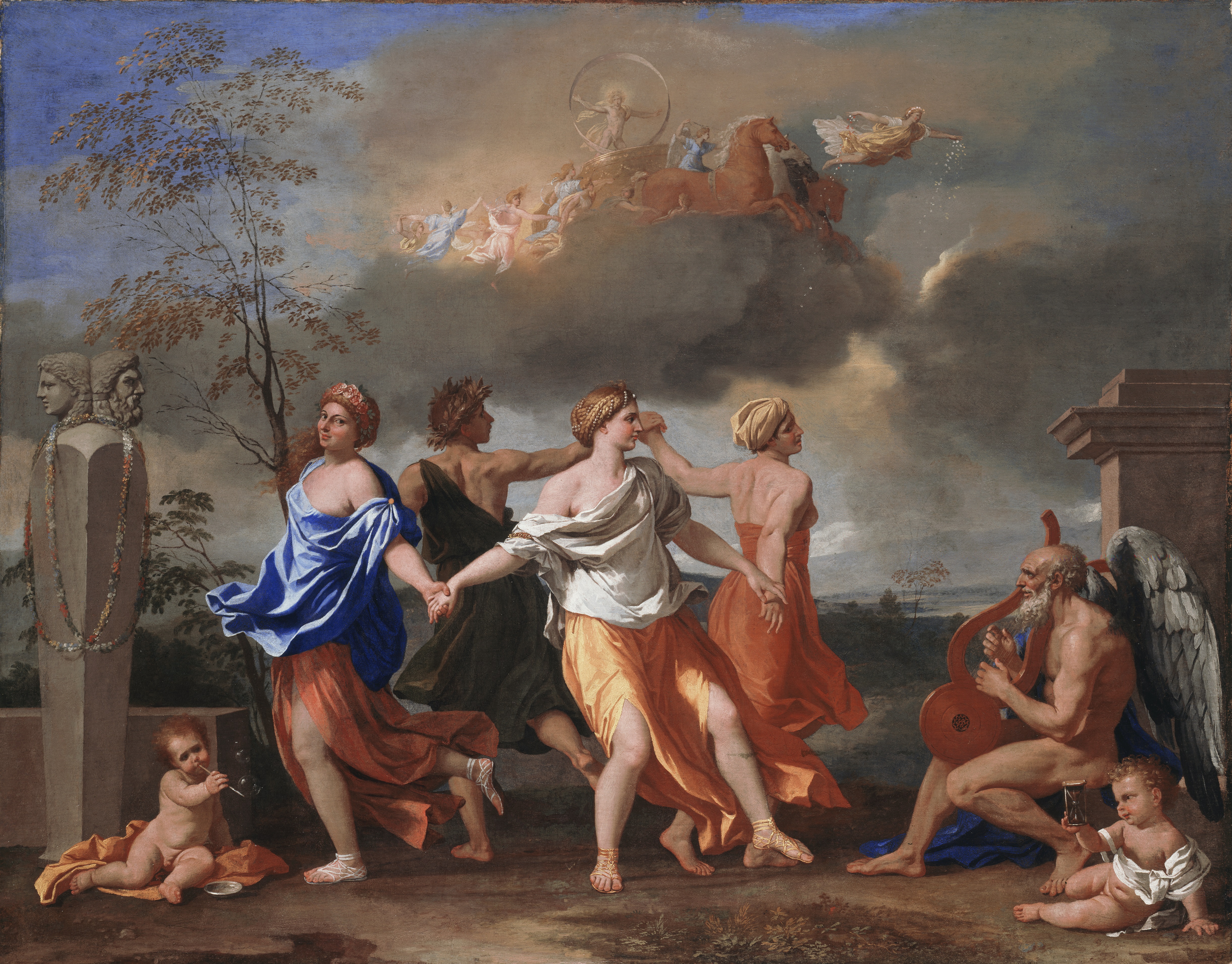
    Three paintings much in the taste of the cardinal duc 
    and his collection at le château.

    "These classical projections, and something from the fire, suddenly suggested Poussin's scene in which the Seasons, hand in hand and facing outward, tread in rhythm to the notes of the lyre that the winged and naked greybeard plays. The image of Time brought thoughts of mortality: of human beings, facing outward like the Seasons, moving hand in hand in intricate measure, stepping slowly, methodically sometimes a trifle awkwardly, in evolutions that take recognizable shape: or breaking into seemingly meaningless gyrations, while partners disappear only to reappear again, once more giving pattern to the spectacle: unable to control the melody, unable, perhaps, to control the steps of the dance."
    Anthony Powell - 'A question of upbringing'

    A nativity by Phillipe de Champaigne with a neo-classical cabinet & statue

    A fragment of another canvas by Philippe de Champaigne with an urn.
    ***