The topics of this blog are Armand-Jean du Plessis, Cardinal Duke of Richelieu, and the IDEAL CITY built on his command next to his magnificent CHÂTEAU on the borders of Touraine, Anjou and Poitou, in France.

Friday, 24 October 2008

Blog followers


Writing a blog, like all writing, is a rather lonely activity.  Each post is shot off into the  e-choing e-ther when one hits the publish post button.  But is anyone out there....?

FOLLOWERS are simply those who read and follow the blog.  Now one can show the author that you really are there, and further, show this fact to other readers.  It can build a sort of community of interest, as it also allows one to get in contact with other readers of the blog.

So how does one become a follower?
(sounds a bit biblical, n'est-ce pas!)

On the top panel on the left there is a Follow this Blog button that highlights in red when the cursor is over it.  Click on it to reveal a dialogue box.  It asks you to get a Google account (this is 'free'). This allows Google to connect other followers with your Google 'profile' and maybe your e-mail address, all fully protected with a password.  You can decide to remain mysteriously private to the world, or more confidently have your picture added along side those in the community already displayed.  
(24 October 2008 - 2 followers so far)

Please try it out!

bisous (hugs)
feu Abbé Henri Proust

Monday, 20 October 2008

* * * * * seeing stars * * * * *

Somewhere out there - in a far and distant e-land, someone asserts that this diagram is the authentic 'star chart' of the great Cardinal.  

All his great works are foretold and the day of his death reliably forecast - allegedly!
What tosh! - isn't it?

Thursday, 16 October 2008

Henry James writes about Touraine in 1884


Henry James
Chapter 1

I am ashamed to begin with saying that Touraine is the garden of France; that remark has long ago lost its bloom. The town of Tours, however, has something sweet and bright, which suggests that it is surrounded by a land of fruits. It is a very agreeable little city; few towns of its size are more ripe, more complete, or, I should suppose, in better humor with themselves and less disposed to envy the responsibilities of bigger places.

It is truly the capital of its smiling province; a region of easy abundance, of good living, of genial, comfortable, optimistic, rather indolent opinions. Balzac says in one of his tales that the real tourangeau will not make an effort, or displace himself even, to go in search of a pleasure; and it is not difficult to understand the sources of this amiable cynicism. He must have a vague conviction that he can only lose by almost any change. Fortune has been kind to him: he lives in a temperate, reasonable, sociable climate, on the banks, of a river which, it is true, sometimes floods the country around it, but of which the ravages appear to be so easily repaired that its aggressions may perhaps be regarded (in a region where so many good things are certain) merely as an occasion for healthy suspense. He is surrounded by fine old traditions, religious, social, architectural, culinary; and he may have the satisfaction of feeling that he is French to the core. No part of his admirable country is more characteristically national. Normandy is Normandy, Burgundy is Burgundy, Provence is Provence; but Touraine is essentially France. It is the land of Rabelais, of Descartes, of Balzac, of good books and good company, as well as good dinners and good houses. 

George Sand has somewhere a charming passage about the mildness, the convenient quality, of the physical conditions of central France, - son climat souple et chaud, ses pluies abondantes et courtes. In the autumn of 1882 the rains perhaps were less short than abundant; but when the days were fine it was impossible that anything in the way of weather could be more charming. The vineyards and orchards looked rich in the fresh, gay light; cultivation was everywhere, but everywhere it seemed to be easy. There was no visible poverty; thrift and success presented themselves as matters of good taste. The white caps of the women glittered in the sunshine, and their well-made sabots clicked cheerfully on the hard, clean roads. 

Touraine is a land of old châteaux, - a gallery of architectural specimens and of large hereditary properties. The peasantry have less of the luxury of ownership than in most other parts of France; though they have enough of it to give them quite their share of that shrewdly conservative look which, in the little, chaffering, place of the market-town, the stranger observes so often in the wrinkled brown masks that surmount the agricultural blouse. This is, moreover, the heart of the old French monarchy; and as that monarchy was splendid and picturesque, a reflection of the splendor still glitters in the current of the Loire. Some of the most striking events of French history have occurred on the banks of that river, and the soil it waters bloomed for a while with the flowering of the Renaissance. 

The Loire gives a great 'style' to a landscape of which the features are not, as the phrase is, prominent, and carries the eye to distances even more poetic than the green horizons of Touraine. It is a very fitful stream, and is sometimes observed to run thin and expose all the crudities of its channel - a great defect certainly in a river which is so much depended upon to give an air to the places it waters. But I speak of it as I saw it last; full, tranquil, powerful, bending in large slow curves, and sending back half the light of the sky. Nothing can be finer than the view of its course which you get from the battlements and terraces of Amboise. As I looked down on it from that elevation one lovely Sunday morning, through a mild glitter of autumn sunshine, it seemed the very model of a generous, beneficent stream. The most charming part of Tours is naturally the shaded quay that over looks it, and looks across too at the friendly faubourg of Saint Symphorien and at the terraced heights which rise above this. Indeed, throughout Touraine, it is half the charm of the Loire that you can travel beside it. The great dike which protects it, or, protects the country from it, from Blois to Angers, is an admirable road; and on the other side, as well, the highway constantly keeps it company. A wide river, as you follow a wide road, is excellent company; it heightens and shortens the way.

The inns at Tours are in another quarter, and one of them, which is midway between the town and the station, is very good. It is worth mentioning for the fact that every one belonging to it is extraordinarily polite, - so unnaturally polite as at first to excite your suspicion that the hotel has some hidden vice, so that the waiters and chambermaids are trying to pacify you in advance. There was one waiter in especial who was the most accomplished social being I have ever encountered; from morning till night he kept up an inarticulate murmur of urbanity, like the hum of a spinning-top. I may add that I discovered no dark secrets at the Hôtel de l'Univers; for it is not a secret to any traveller today that the obligation to partake of a lukewarm dinner in an overheated room is as imperative as it is detestable. For the rest, at Tours, there is a certain rue Royale which has pretensions to the monumental; it was constructed a hundred years ago, and the houses, all alike, have on a moderate scale a pompous eighteenth-century look. It connects the Palais de Justice, the most important secular building in the town, with the long bridge which spans the Loire, - the spacious, solid bridge pronounced by Balzac, in Le Curé de Tours, "one of the finest monuments of French architecture." The Palais de Justice was the seat of the Government of Leon Gambetta in the autumn of 1870, after the dictator had been obliged to retire in his balloon from Paris, and before the Assembly was constituted at Bordeaux. The Germans occupied Tours during that terrible winter; it is astonishing, the number of places the Germans occupied. It is hardly too much to say that wherever one goes in, certain parts of France, one encounters two great historic facts: one is the Revolution; the other is the German invasion. The traces of the Revolution remain in a hundred scars and bruises and mutilations, but the visible marks of the war of 1870 have passed away. 

The country is so rich, so living, that she has been able to dress her wounds, to hold up her head, to smile again; so that the shadow of that darkness has ceased to rest upon her. But what you do not see you still may hear; and one remembers with a certain shudder that only a few short years ago this province, so intimately French, was under the heel of a foreign foe. To be intimately French was apparently not a safeguard; for so successful an invader it could only be a challenge. Peace and plenty, however, have succeeded that episode; and among the gardens and vineyards of Touraine it seems, only a legend the more in a country of legends.

It was not, all the same, for the sake of this checkered story that I mentioned the Palais de Justice and the rue Royale. The most interesting fact, to my mind, about the high street of Tours was that as you walked toward the bridge on the right-hand trottoir you can look up at the house, on the other side of the way, in which Honoré de Balzac first saw the light. That violent and complicated genius was a child of the good-humored and succulent Touraine. There is something anomalous in the fact, though, if one thinks about it a little, one may discover certain correspondences between his character and that of his native province. Strenuous, laborious, constantly infelicitous in spite of his great successes, he suggests at times a very different set of influences. But he had his jovial, full-feeding side, - the side that comes out in the Contes Drolatiques, which are the romantic and epicurean chronicle of the old manors and abbeys of this region. And he was, moreover, the product of a soil into which a great deal of history had been trodden. Balzac was genuinely as well as affectedly monarchical, and he was saturated with, a sense of the past. 

Number 39 rue Royale - of which the basement, like all the basements in the rue Royale, is occupied by a shop - is not shown to the public; and I know not whether tradition designates the chamber in which the author of Le Lys dans la Vallée opened his eyes into a world in which he was to see and to imagine such extraordinary things. If this were the case, I would willingly have crossed its threshold; not for the sake of any relic of the great novelist which it may possibly contain, nor even for that of any mystic virtue which may be supposed to reside within its walls, but simply because to look at those four modest walls can hardly fail to give one a strong impression of the force of human endeavor. Balzac, in the maturity of his vision, took in more of human life than anyone, since Shakespeare, who has attempted to tell us stories about it; and the very small scene on which his consciousness dawned is one end of the immense scale that he traversed. I confess it shocked me a little to find that he was born in a house "in a row," - a house, moreover, which at the date of his birth must have been only about twenty years old. All that is contradictory. If the tenement selected for this honour could not be ancient and em-browned, it should at least have been detached.

There is a charming description, in his little tale of La Grenadière, of the view of the opposite side of the Loire as you have it from the square at the end of the Rue Royale, - a square that has some pretensions to grandeur, overlooked as it is by the Hôtel de Ville and the Musée, a pair of edifices which directly contemplate the river, and ornamented with marble images of Francois Rabelais and Rene Descartes. The former, erected a few years since, is a very honorable production; the pedestal of the latter could, as a matter of course, only be inscribed with the Cogito, ergo sum. The two statues mark the two opposite poles to which the brilliant French mind has travelled; and if there were an effigy of Balzac at Tours, it ought to stand midway between them. Not that he, by any means always struck the happy mean between the sensible and the metaphysical; but one may say of him that half of his genius looks in one direction and half in the other. The side that turns toward Francois Rabelais would be, on the whole, the side that takes the sun. But there is no statue of Balzac at Tours; there is only, in one of the chambers of the melancholy museum, a rather clever, coarse bust. The description in La Grenadière, of which I just spoke, is too long to quote; neither have I space for any one of the brilliant attempts at landscape painting which are woven into the shimmering texture of Le Lys dans la Vallée. The little manor of Cloche-gourde, the residence of Madame de Mortsauf, the heroine of that extraordinary work, was within a moderate walk of Tours, and the picture in the novel is presumably a copy from an original which it would be possible to-day to discover. I did not, however, even make the attempt. There are so many châteaux in Touraine commemorated in history, that it would take one too far to look up those which have been commemorated in fiction. 

The most I did was to endeavor to identify the former residence of Mademoiselle Gamard, the sinister old maid of Le Curé de Tours. This terrible woman occupied a small house in the rear of the cathedral, where I spent a whole morning in wondering rather stupidly which house it could be. To reach the cathedral from the little place where we stopped just now to look across at the Grenadière, without, it must be confessed, very vividly seeing it, you follow the quay to the right, and pass out of sight of the charming côteau which, from beyond the river, faces the town, - a soft agglomeration of gardens, vineyards, scattered villas, gables and turrets of slate- roofed châteaux, terraces with gray balustrades, moss- grown walls draped in scarlet Virginia-creeper. 

You turn into the town again beside a great military barrack which is ornamented with a rugged mediaeval tower, a relic of the ancient fortifications, known to the tourangeaux of to-day as the Tour de Guise. The young Prince of Joinville, son of that Duke of Guise who was murdered by the order of Henry II at Blois, was, after the death of his father, confined here for more than two years, but made his escape one summer evening in 1591, under the nose of his keepers, with a gallant audacity which has attached the memory of the exploit to his sullen-looking prison. Tours has a garrison of five regiments, and the little red-legged soldiers light up the town. You see them stroll upon the clean, un-commercial quay, where there are no signs of navigation, not even by oar, no barrels nor bales, no loading nor unloading, no masts against the sky nor booming of steam in the air. The most active business that goes on there is that patient and fruitless angling, in which the French, as the votaries of art for art, excel all other people. The little soldiers, weighed down by the contents of their enormous pockets, pass with respect from one of these masters of the rod to the other, as he sits soaking an indefinite bait in the large, indifferent stream. 

After you turn your back to the quay you have only to go a little way before you reach the cathedral.


Honoré de Balzac

Tuesday, 14 October 2008

The digital cadastral plan of Richelieu

This is the digital cadastral plan of the walled and moated town of Richelieu.  This French national service allows anybody to download detailed maps of their property. Like most digital map work it is is of astonishing accuracy.  I have now paid my 9.50€ and have a full digital survey map of the town within the walls - intramuros as they call it.  And I have succeeded in translating the dxf file version into a working CAD file, such as our office uses all the time.  One can order large paper prints but that is not the prudent and ecomomical way to go!

Philippe de Champaigne's house in Paris - 1645


Philippe de Champaigne's house at 11 Quai de Bourbon, Ile Saint Louis, Paris. Champaigne was the favourite painter of the cardinal de Richelieu and the author of the many official portraits and the famous triple portrait sent to Bernini as a guide to carve the bust of the cardinal while the artist remained in Rome.

Thursday, 9 October 2008

The state barge of Cardinal de Richelieu on the Rhone


Paul Delaroche   1797-1856

"He was borne along the river Rhone in a boat in which a wooden chamber had been
constructed, lined with crimson fluted velvet, the flooring of which
was of gold. The same boat contained an antechamber decorated in
the same manner. The prow and stern of the boat were occupied by
soldiers and guards, wearing scarlet coats embroidered with gold,
silver, and silk; and many lords of note. His Eminence occupied a
bed hung with purple taffetas. Monseigneur the Cardinal Bigni, and
Messeigneurs the Bishops of Nantes and Chartres, were there, with
many abbés and gentlemen in other boats. Preceding his vessel, a
boat sounded the passages, and another boat followed, filled with
arquebusiers and officers to command them. When they approached any
isle, they sent soldiers to inspect it, to discover whether it was
occupied by any suspicious persons; and, not meeting any, they
guarded the shore until two boats which followed had passed. They
were filled with the nobility and well-armed soldiers.

"Afterward came the boat of his Eminence, to the stern of which was
attached a little boat, which conveyed MM. de Thou and Cinq-Mars,
guarded by an officer of the King's guard and twelve guards from the
regiment of his Eminence. Three vessels, containing the clothes and
plate of his Eminence, with several gentlemen and soldiers, followed
the boats.

"Two companies of light-horsemen followed the banks of the Rhone in
Dauphin, and as many on the Languedoc and Vivarais side, and a noble
regiment of foot, who preceded his Eminence in the towns which he
was to enter, or in which he was to sleep. It was pleasant to
listen to the trumpets, which, played in Dauphine, were answered by
those in Vivarais, and repeated by the echoes of our rocks. It
seemed as if all were trying which could play best."

Alfred de Vigny - 'Cinq-Mars, ou une Conjuration sous Louis XIII' - 1827

This famous work of 1829 shows Cardinal Richelieu in a gorgeous barge, preceding the boat carrying Cinq-Mars and De Thou as they are carried to the place of execution, following their conspiracy and treason.

Hippolyte (Paul) Delaroche was a French painter, born into a wealthy family in Paris on the 17th July 1797. He was determined to become an artist. 
His father was successful in negotiating and cataloguing, buying and selling paintings. He was proud of his son's talent, and decided to enable his artistic education. In 1818 Paul Delaroche entered the studio of Antoine-Jean Gros. Delaroche is best known today as a representative of French Academicism.

Delaroche made his début at the Salon in 1822 with Christ descended from the cross and Jehosheba saving Joash. This established him as an artist and put him in central group of historical painters with Gericault and Delacroix with whom he became friends. The three were the central triad of a large number of historical painters the like of which has never existed before in one locality and at one time.

Delaroche's response to the Romantic challenge to the contemporary dominance of Neo-classicism was to conduct a course between these two currents. His public standing became strong with views of historic subjects expressed in popular romantic manner, painted with a solid smooth surface which gave an appearance of the highest quality finish.

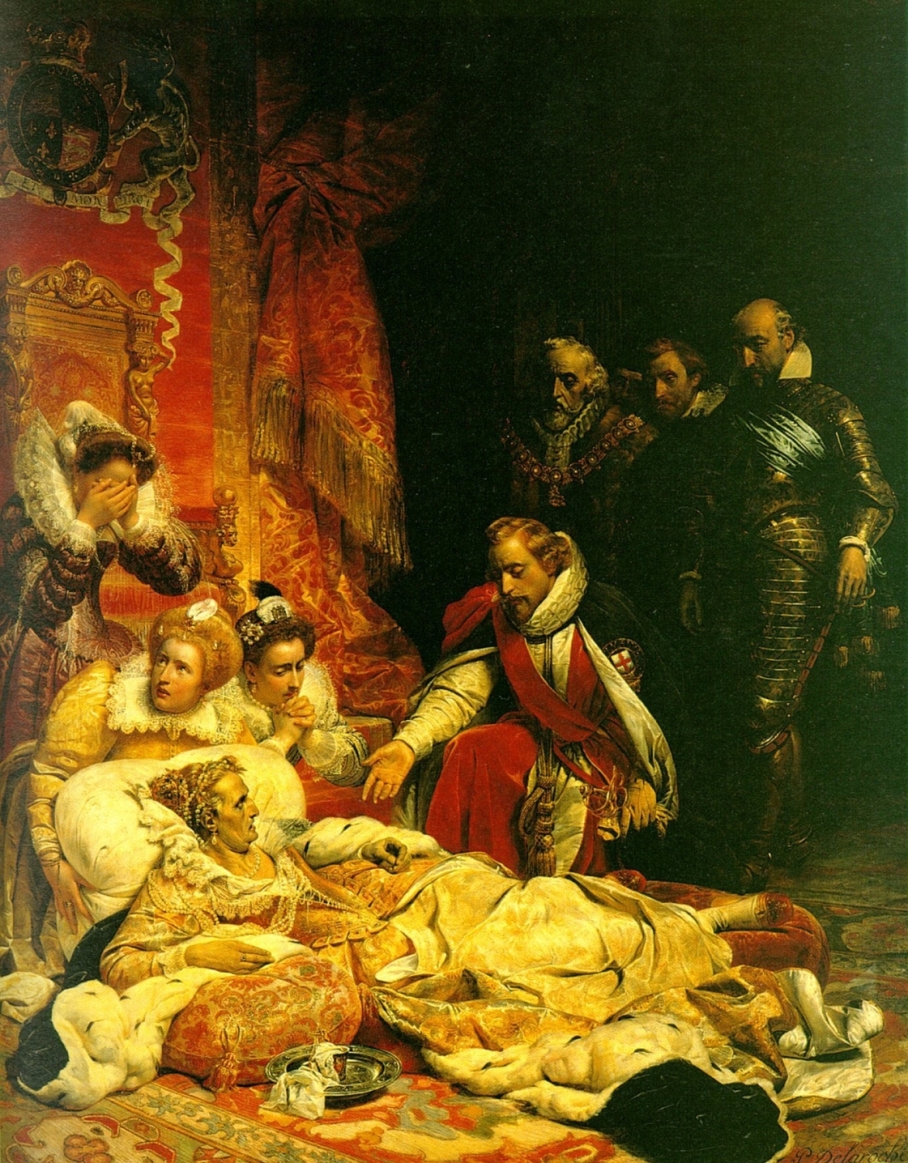
His work was not always historically accurate. Cromwell lifting the Coffin-lid and looking at the Body of Charles is an incident only to be excused by an improbable tradition. The King in the Guard-Room, with villainous roundhead soldiers blowing tobacco smoke in his patient face, is a libel on the Puritans. Queen Elizabeth dying on the Ground, like a she-dragon no one dares to touch, is sensational. The Execution of Lady Jane Grey is represented as taking place in a dungeon, which is badly inaccurate.

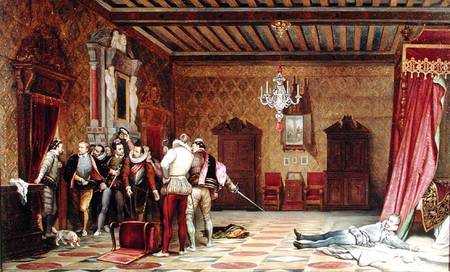
His 1835 Assassination of the duke de Guise at Blois is an exacting historical study was well a dramatic insight into human nature. Other important Delaroche works include The Princes in the Tower and the La Jeune Martyr (a young female martyr floating drowned in the Tiber).

Delaroche died on the 4th of November 1856.
Today this painting is located in the Wallace Collection, London.

Monday, 6 October 2008

The château de Thouars


As the château de Richelieu was demolished in the 1830's, many have tried to speculate what it was actually like.

One way is to create a computer model of the building and to look at it in a multi-media way. This has been done and the results can be seen in stereo at No.28 Grande Rue, Richelieu, or by looking at these web-sites that have video clips of the project. 

Another is to look at the very extensive contemporary graphic coverage of the buildings.

A third way is to go and look at buildings that still exist today that were built by the same building team.

Duke and Peer Henri de La Trémoille married Marie de La Tour d'Auvergne in 1619. Both aristocrats were initially Hugenots. As Richelieu rose to power and sought to reduce the power of widespread protestantism, the Duke revoked his calvinism and established himself afresh in Louis XIII's catholic court in Paris. (Was he following the political pragmatism of king Henri IV)? His wife however remained non-catholic and never went again to Court.

After a small improvement made to the mediaeval castle on the precipitous site in Thouars, the Duke and Duchess decided to entirely rebuild the castle, and used the king's (and Richelieu's) architect Jacques Lemercier and many members of the team from the recently completed Château de Richelieu. Thouars is about 50 kilometers to the west of Richelieu, in the department of Deux-Sèvres.

Thouars castle remains intact, having had many uses in the meantime; today being a secondary school and college. A restoration project has been underway for the last 15 years and still continues. The building, while of a different plan format as a consequence of its site, seems to be a close cousin of the building in Richelieu, although the style is much more severe as a result of the family's protestant inclinations. In comparison, the decoration is very subdued and extensive statuary, the result of Counter-Reformation Italianate influence emphasised by the Cardinal as part of his greater political project, almost entirely absent.

Wednesday, 24 September 2008

Cannelés bordelais


Not much to do with Richelieu really - but they are rather nice and the Abbé Henri has just perfected their preparation.  Cannelés (or if authentically from Bordeaux 'canelés bordelais') are small caramelised crunchy/gooey cakes that taste like vanilla ice cream but without the ice and without the cream.  Served with a crème anglaise or custard the are pretty nice to eat, so here is the recipe:

Step 1:
Cannalé moulds; individual moulds of tinned copper are very pretty, but don't be tempted by authenticity as getting the little blighters out when they are hot is a nghtmare.....so.....acquire a lovely new silicone 8-cannelé mould from a cooking shop.

Step 2:
Ingredients for 16 cannelés (ie two 8-cannelé moulds)
A 0.5 litre full milk
B 2 whole eggs
C 2 egg yolks
D 2-4 vanilla beans (fresher are better than dried out; not vanilla extract)
E 1.5 tablespoons dark 'Navy' rum
F 100 grams plain flour
G 200-250 grams caster sugar (more or less sweet to choice)
H 50 grams butter (reduce to 25 grams? - omit entirely?)

Step 3 
Preparation stage 1
1 Split the vanilla beans length-wise and scrape out the precious seeds
2 Add beans seeds and butter to the milk, bring to the boil and take off heat
3 Mix the flour, sugar, eggs and egg yolks in a bowl
4 Whisk at high speed for 3-5 minutes
5 Remove bean casings from the warm milk and transfer it gradually into the flour mix bowl
6 Add all the vanilla milk to the flour (with all the seeds but not the beans)
7 Whisk for 3-5 minutes as before
8 Cool the mix for 1 hour and then mix in the rum
9 Cool the mixture overnight in a fridge (or some say for 24 hours)

Step 4
Preparation stage 2 (next day)
1 Preheat the oven to 270 deg C (520 deg F); this is usually right at the maximum for most domestic ovens (slightly less for fan ovens)
2 Fill all the 8 moulds to 80%; don't leave any empty
3 BAKE at high temperature for 6-9 minutes (more or less caramelised outside), then
4 Reduce oven temperature to 180 deg C (350 deg F) and BAKE for at least another 1 hour (more or less gooey/cakey inside)
5 Cover with aluminium foil after 20 minutes of the hour
6 Take the mould out of the oven and invert onto a pie grid and let cool
7 After 10 minutes tap the canelés out from the silicone mould without damaging them

Step 5; Consumption
Two each. They are best after 1 hour; they can be frozen; they go rubbery if left out any real time.
Serve with real custard or crème anglaise (or maybe with real vanilla ice cream).

Would be nice with a bottle of Coteaux de Layon, or even a half bottle of Bonnezeaux


Monday, 22 September 2008

Bowled over by melons


The summer months of July and August are those of the orange fleshed cantaloupe melon, which is extensively farmed in Haut Poitou just next to Richelieu.  We were directed to go to Chapeau Melon - halfway between Richelieu and Loudun - and award them the family supply contract.  It is astonishing just how much melon one can happily eat on an August evening.  And the peak season prices are a delight.

p.s. un chapeau melon = a bowler hat; geddit!

Thursday, 18 September 2008

The façade of 14 Grande Rue


There are 28 mansions that line the Grande Rue, each originally built to the same design specification.  It is one of the largest collections of authentic seventeenth century houses in a single artistic composition in France. Until recently, several of these grand houses were in very poor condition, and finding the right use for such large houses has not been entirely easy.  They are too large for any individual's funds but too modest for a national monument. There is much earnest discussion as to appropriate use and whether 'any old use' that allows prompt restoration would be more relevant than patiently awaiting the perfect restoration context, perhaps ensuring complete and terminal dereliction.  No.14 was in truely awful condition. For a while it seemed to be in the sights of the Mairie, to act as the town's own museum mansion for visitors and tourists.  It was favoured as the particular site allows a rear public emergency exit to rue Henri Proust. But when the town chose No.28 Grande Rue instead, this building was reconceived as apartments for seniors, people in retirement (there are a lot of people en retraite in France as a consequence of the generous  provisions of the modèle sociale).

One of the wonderful aspects of buildings of this period is that they restore so well, and soon show the graceful quality of much French 17th century art.  So it is now with No.14.  There is a general policy to remove any commercial activity on the ground floor of these mansions and even if some retail is unavoidable by established rights, to restore the fenestration so that only the spandrels below the original window openings are altered. The incorporation of complete modern glassy retail façades is taboo. Commercial activity is to be encouraged in the two main squares, as was the intention of the original conception of designer Jacques Lemercier and the Cardinal Duc himself.

Wednesday, 17 September 2008

The château & town's water system (2) - in photographs

A former post written by chief architect of Les Monuments Historiques, Arnaud de Saint-Jouan, described the château and town's water supply system. Here are sylvan pictures of the various installations to match the very interesting and informative text. (Items references refer to the text).

Click here for the text.

The 17 century spring chamber at Bisseuil (item O)

The water aerator outside the castle (item P)


The town's old water tower fed from Bisseuil 


The Bollée hydraulic ram building (item J)

The old electricity generator building (item J)


The sluice from the ram and the powerstation (item G)


The sluice flowing past the hydraulic ram (item G)


The current supply canal in its 19 century relocation (item D)


The grand canal looking south towards the original 17 century feeder canal and sluices location (item E), now largely blocked and silted up

The sad location of the derelict embarquadère on the grand canal, demolished in 2007 (item L)


The inaccessible location of the reservoir, within the walled hunting park with the wild boar (item M)


The view of the grand canal's exit sluices from the main park (item F)


The main exit sluices (item F)

The sluice's stonework abutments (item F)


The final overflow pond before the entry to the town's moat, now partially planted with poplars (item I)