The topics of this blog are Armand-Jean du Plessis, Cardinal Duke of Richelieu, and the IDEAL CITY built on his command next to his magnificent CHÂTEAU on the borders of Touraine, Anjou and Poitou, in France.

Saturday, 2 October 2010

....where are the bar staff?

Richelieu brandy's the toast of Zambia and South Africa......apparently.
***

Wednesday, 15 September 2010

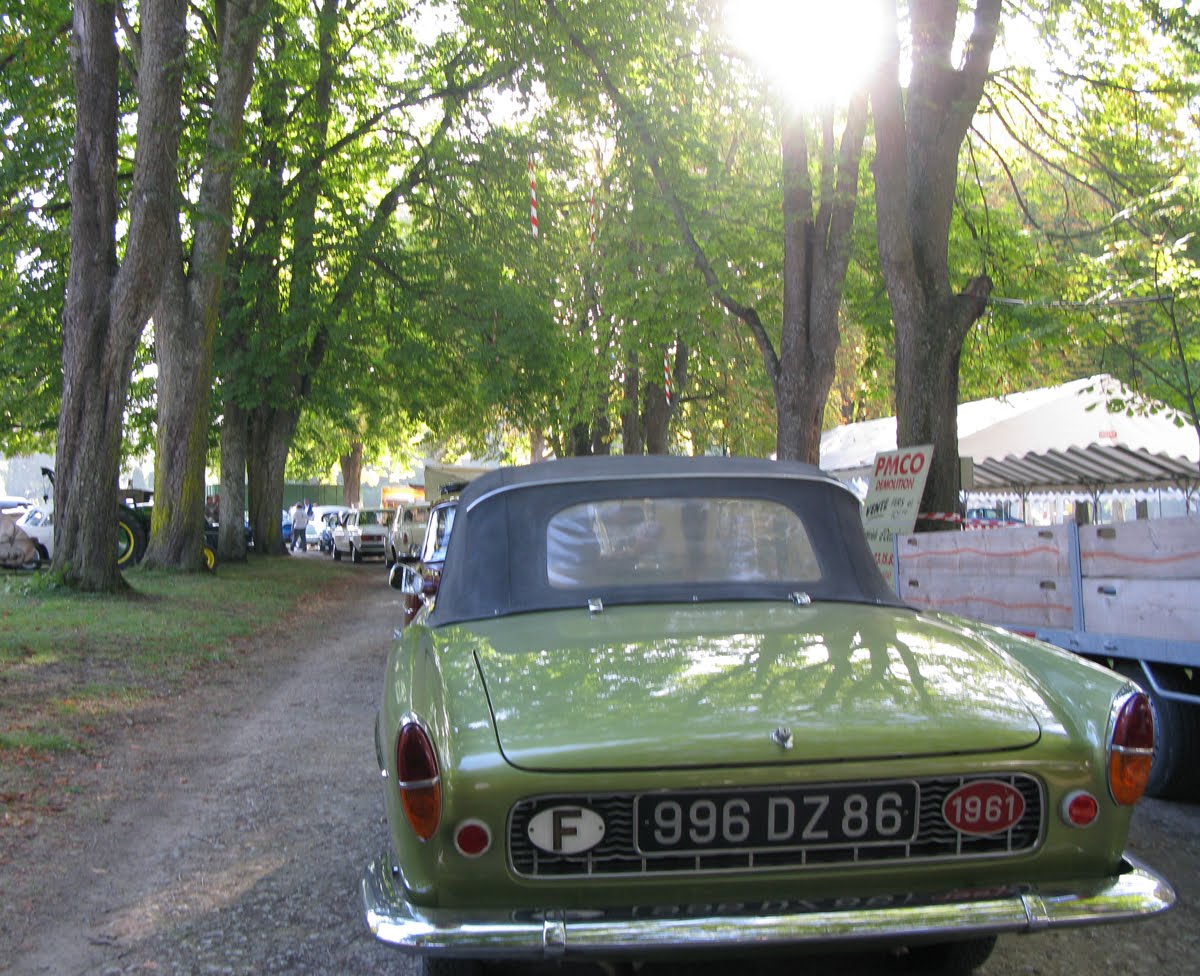
'La Locomotion' - the biennial car meet

Every second year the AUVL (Association d'Utilitaires de la Vallée de la Loire) organises a huge rendez-vous of old vehilcles that fills the cardinal duc's parc for a weekend.  This time, for 2010, it also hosted the GREC (Grande Rassemblement Européene Cadillac) with the Cadillac LaSalle Club France as specialist hosts.

The highlight really is the Sunday morning run that cruised 50 km around the various cantons of the pays de Richelieu followed by a communal motorist's luncheon under the trees of the park.

We must briefly mention those plucky motorists from the Bristol Austin Seven Club who managed to wobble their way from their home to this distant parc.  A 1930's radiator was replaced at the roadside by their mechanical wizards from Birmingham hidden (allegedly) in the club's only-too-Gallic corrugated Citroën H support van.

Below a collection of images of the meeting.


Tuesday, 14 September 2010

Lime rendering a garden wall

The garden walls of 16 Grande Rue are shown being re-rendered in lime mortar.  First, all the old lime render was hacked off, and then the two artisans started on this skilled task that will entirely encase the old 17th century coursed rubble wall within.  Hand skills such as this are still quite the norm in the Loire valley.  There are so many historic buildings of quality that require these traditional skills to survive, that it is expected that non-specialist builders can execute them as much their conservation specialist colleagues.


click on the image for a nice big version to open
***

Sunday, 12 September 2010

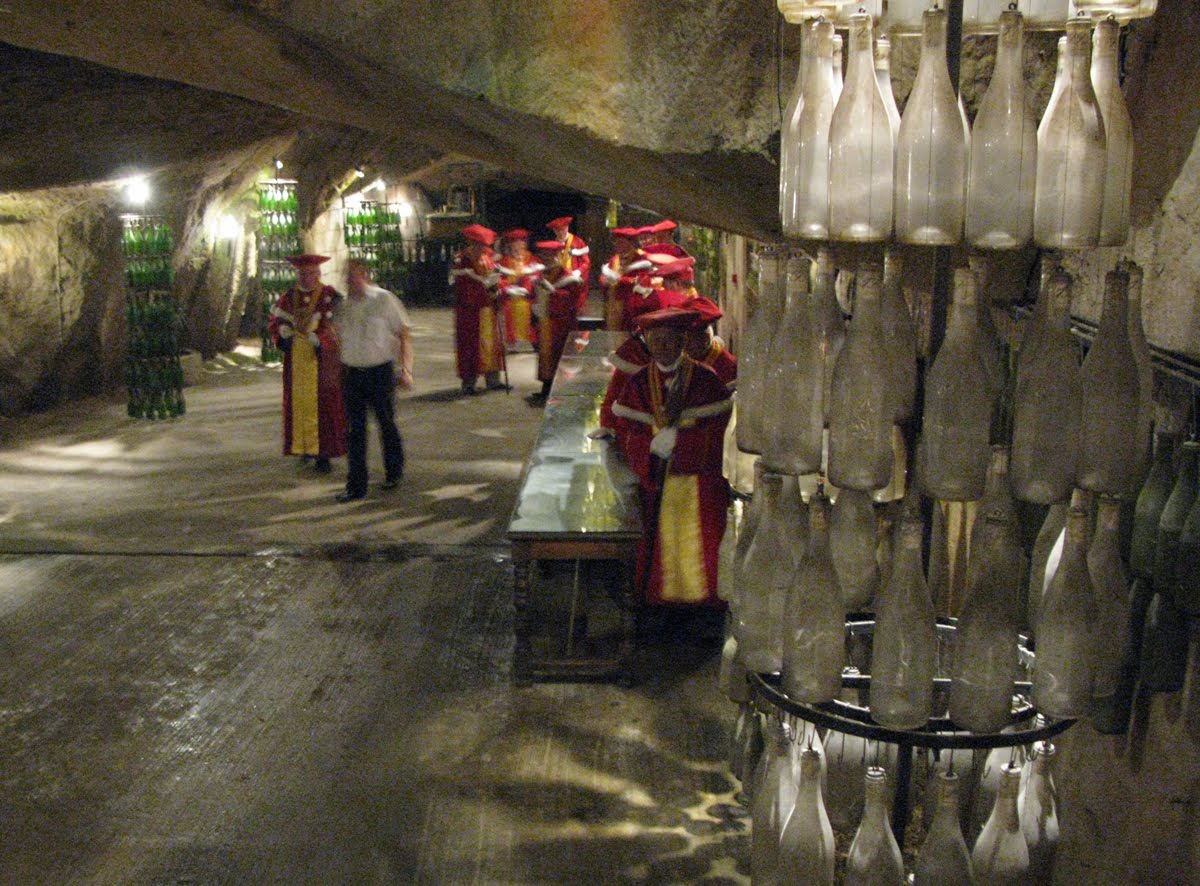
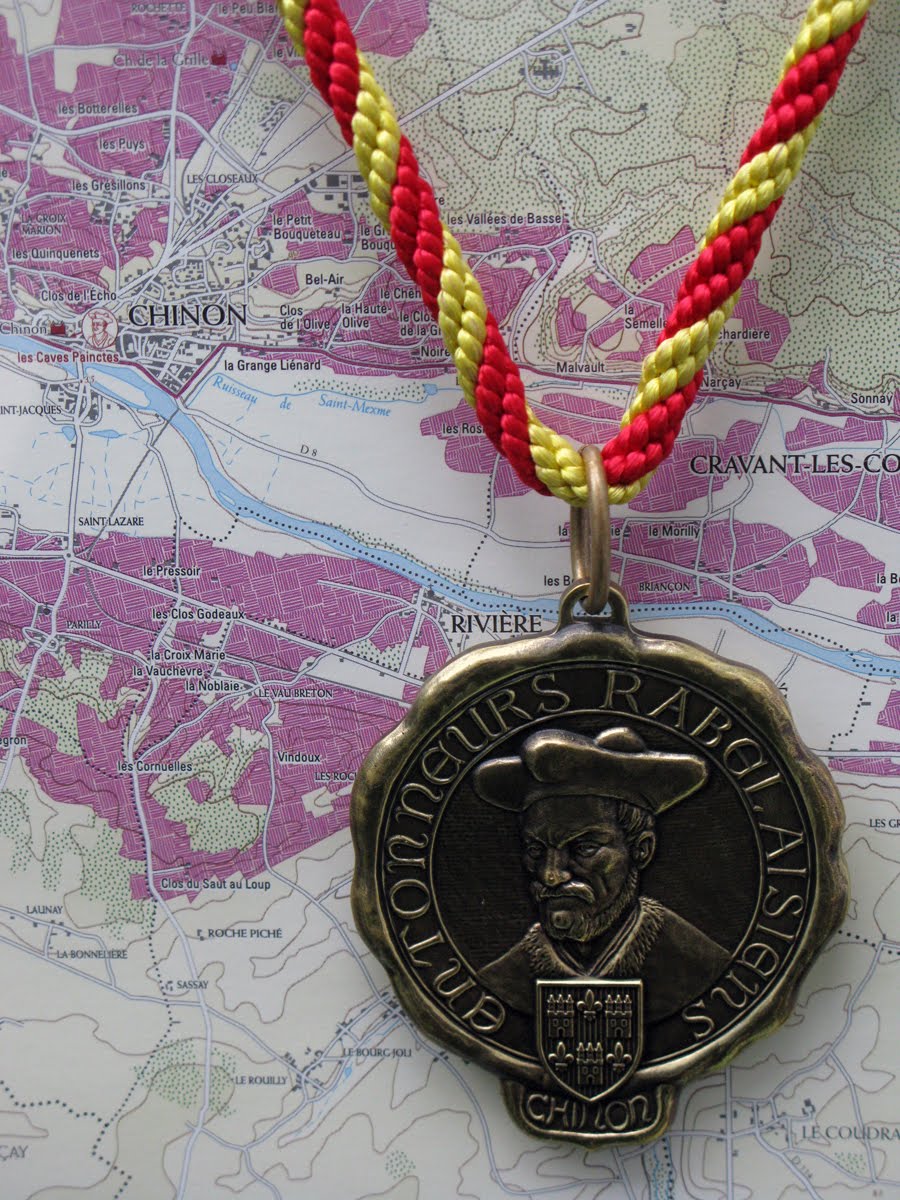
Les Caves Painctes in Chinon and the Entonneurs Rabelaisiens


Here is a short movie of a gala dinner held in the underground 'Caves Painctes' in the ancient Plantagenet town of Chinon, located deep within the castle rock itself.  Allegedly, this is the location of the cellars owned by the father of the 16th century Humanist writer François Rabelais, and referred to directly in the 1534 adventures of the giant Gargantua and his own son Pantagruel.  A ritual ceremony installed a few of the 300-strong Cadillac Lasalle Club France party into the society of 'Entonneurs Rabelaisiens - the funnelers/barrel fillers(?) of Rabelais', a dinner club started in 1962 that celebrates the famous red wine of Chinon and its most fervent admirer, François Rabelais himself.

Your blog's author, the Abbé Henri Proust, was elevated to the rank of Chevalier of the Entonneurs Rabelaisiens on the 3rd of September 2010 (for services rendered etc.....).  What an honor, and frankly what a responsibility!; to act as advocate for the Humanist and gourmand world-view of Rabelais and as an ambassador for the gorgeous cabernet franc wines of AOC Chinon.

HARD work; but someone has to do it!

Readers, friends, if you turn these pages
Put your prejudice aside,
For, really, there's nothing here that's outrageous,
Nothing sick, or bad — or contagious.
Not that I sit here glowing with pride
For my book: all you'll find is laughter:
That's all the glory my heart is after,
Seeing how sorrow eats you, defeats you.
I'd rather write about laughing than crying,
For laughter makes men human, and courageous.
BE HAPPY!

***

< Beuvez tousjours, vous ne mourrez jamais >

Sunday, 8 August 2010

The new music widget

Henri Proust has added a music 'widget' in the side bar to the right, having found it on another blog http://versaillesdailyphoto.blogspot.com/

All one has to do is click on the little arrow and a playlist of French period music will play while you look at the blog site.  HP couldn't figure out how to implant a new playlist of his own, so he has filched the one from the site about daily Versailles photographs.  

One day when he has time he will try to work it all out and get music from the seventeenth century rather than the eighteenth.

***

Tuesday, 3 August 2010

Inside 15 Grande Rue - formerly 'Le musée du chat'

During the festival of Cape and Rapier, it was possible to look into the back court of the hôtel particulier that was formerly Madame Le Roy's Musée du chat - the cat museum - number 15 Grande Rue.  It has new owners and has been cleared so that restoration can be carried out.  Today this building is the only hôtel on the Grande Rue that is not finished in lime render.  Although the exposed rubble walls have picturesque qualities to today's eye, this would have looked very common to the 17th century owner, as it would tell that the owner was a more a farmer or other rude mechanical than a gentleman.  The cardinal's original detailed specification for the houses asked for rendered façades to the mansions, with tuffeau ashlar quoins and string courses.  Perhaps economy would drive the rear dependances and stables to be more humble and to have exposed coursed rubble walls (and even vulgar roman tiled roofs!), but  the removal of the render from the main house facades would have been unthinkable, both for reasons of watertightness and of blatant snobbery.  One can see in the ashlar-work window surrounds, where the particular stone used happened to be too large, that the original mason has hacked the face back to allow the adhesion of the render that he assumed was to follow.  One can observe this detail in the re-rendering of other Grand Rue houses too.

But nonetheless the stripped old building has a particular charm.  Madame Le Roy had laid out a picturesque garden too, but this has been cleared as well.
The rather lumpy building at the foot of the garden on the site of the hôtel's écuries or stables needs re-roofing to replace the nasty cement tiles used in the late nineteenth or early twentieth century on the inauthentic mansard-like roof section.


But soon, presumably, these views will become the 'before shots' of a major restoration.
***

Monday, 2 August 2010

Frédéric Mitterrand marries ‘Culture’ and ‘Tourism’


" The town of Richelieu will now benefit from State support for its future cultural development. The Minister inaugurated the Espace Richelieu:, a cultural centre that tells the story of the cardinal and his ideal town, and signed a three-year agreement of support for the town’s restoration projects.

The Cardinal has always fascinated the man of culture. Frédéric Mitterrand, now the French Minister of Culture, would have talked for hours if only his ministerial duties had not pressed him into a full day of travel all across Touraine.  He finally completed it all with eyes wide open and many an admiring glance.

Before doing a tour of châteaux highlighting the vital work of private owners, the Minister of Culture was greeted in Richelieu by the Mayor, who is none other than his colleague and friend in government, Hervé Novelli, Secretary of State for Tourism.

And if some official visits must sometimes seem tedious, the rediscovery of Touraine by a Frédéric Mitterrand, now in his role of a minister, was anything but a chore.

It must be said that both the Secretary of State for Tourism and Minister of Culture share the belief that the two political portfolios are often complementary, even fusional. Already signatories to a charter to combine tourism and culture to enhance the general attractiveness of the Hexagon – France itself - the two men have now initiated an agreement on cultural development between the State and the humble town of Richelieu for a period lasting three years.

Obviously the Ideal City as conceived by cardinal duc de Richelieu, cannot, with its mere 2,000 souls, carry out alone the development of a 'place that has the capability to become a cultural exception and mediator', in the words of Frédéric Mitterrand, enthusiastic after visiting the new Espace Richelieu:, created in a former grand mansion that had been renovated by the actor Gérard Klein.  The exhibit, with much museum display equipment, a virtual tour of the missing château de Richelieu in stereo 3D, and many other detailed memorabilia, welcomes the visitor and audience at the very heart of the 1640s cité idéale. The agreement will also allow the renovation of les halles, the ancient and original market building from the seventeenth century, and many other actions to enhance the attractiveness of the town of Richelieu, as well as creating a ‘Richelieu Circuit’.

Eloquent about the 'almost Shakespearean dimension of relations between the cardinal duc de Richelieu and King Louis XIII', Frédéric Mitterrand called for a ‘tourism of excellence’ for which Touraine has so many major advantages. The Minister saw confirmation of these qualities throughout the entire day’s visit."

Translated from Patrick Goupil’s article in La Nouvelle Republique 23/7/2010
We hope they won’t mind a little extra media circulation!


The Minister of Culture admits his passion for Richelieu.  The Homme Rouge as he is called on a panel from the exhibit in the Espace Richelieu:, consecrated to the Cardinal in his own town.

Fortresse Royale of Chinon


The castle at Chinon stands over the banks of the Vienne river a kilometre from its confluence with the mighty river Loire.  In mediaeval times this was a strategic as well as a commercial location, as it commanded the main method of movement of the day, river transportation.  In the 1200s The Plantagenet Kings used Chinon as their main Royal castle and from there governed a huge 'empire' that ran from Scotland to the Basque country. While being a vassal of the King of France (then more or less only the Ile de France), the french-speaking Plantagenet Lord a was full King of England, and so a peer of the French King in Paris.  Tricky balance!


The old castle at Chinon is formed of three defensive castles-within-castles and is on a par with the defensive works of the Crusaders or those build by England's Edward 1 in Wales.  The crusades caused defensive architecture to advance a great deal, and this skill was brought back to France from Jerusalem.

The ruin that we find today is the recipient of the largest restoration project work in Europe.  This involves the partial reconstruction of the royal apartments to the earliest state of which there is a sufficiently comprehensive record. We now see the apartments as they were in about 1760.  Sadly the hall where the King of France received the Maid of Orleans, Joan of Arc, remains in ruin as there is no documentation extant to act as guide to reconstruction.

The three photos look up from the mediaeval main-street of the town of Chinon to see the restored apartments outlined against the sky.  The town itself was placed next to the river for both access and defensive reasons, and protected in the rear by the towering castle rock.


***

Monday, 26 July 2010

Fondation du Parimoine - Richelieu's canvases

is an organisation that sponsors cultural projects and invites private and corporate patronage of the historic inheritance of France.  On this site one can see news of the project to restore and then display the huge - 3.5 x 2.6m - battle scenes that were originally created for the gallery of the château de Richelieu.  They told of the great victories of the king Louis XIII and his first minister, the cardinal duc de Richelieu.  They were preserved (sic!) in the château de Versailles.

Once restored, three canvases will be displayed in the museum of Orleans, three in Tours and 
SIX - yes! 6
(three of these need restoration)
in the municipal museum of the town of Richelieu.  One asks why not all of them?  Should we not start a club to ensure the restitution of the Cardinal's famous art collection to its original location in its entirety?  Recreate the gallery in its original location on the island in the parc?  At first floor level maybe?

If you CLICK HERE you can download a document which tells how to subscribe €s to this worthy objective - or download the document you can see at the foot of this post. It tells the story of the project and also tells which restored painting will go where.  Amongst their six canvases, Richelieu will receive these paintings restored:
  • 1   The siege of the Ile de Ré (needs 52,582 euros - 526 persons @ 100€ each!), against the dastardly rosbifs and the Duke of Buckingham, as featured in the Three Musketeers!
  • 2   The Reduction of Nîmes (27,238 euros)
  • 3   The Submission of Montauban (needs 39,067 euros)


You can support this project by subscribing either as an individual or as a company.  The pdf document below tells you about the project and how contribution may be made.
You can even choose which painting to support
Go on! You know you want to.
'cos its worth it
doc_projets_873_735

Tuesday, 13 July 2010

Roof ablaze at the château de Rivau 5km from Richelieu

Read HERE about the recent roof
FIRE
at the château du Rivau,
a building actually referred to in GARGANTUA by Rabelais
located a few kilometres north of the cité idéale.

*****

* 4th Richelieu Music Festival Programme * 29 July - 15 August 2010

Music Fest 4

Tuesday, 15 June 2010

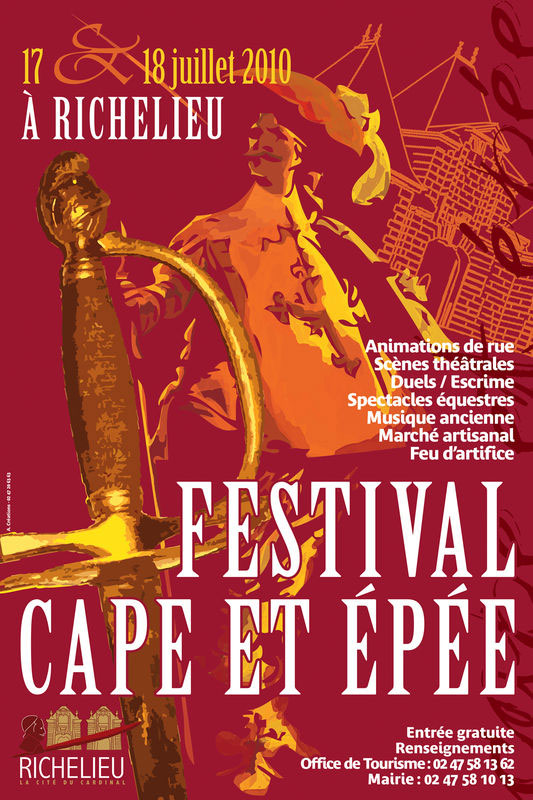
the next fesitival of CAPE AND RAPIER

The biennial festival that relives the fantasy of the 17th century of the world of 'The Three Musketeers' takes place on the weekend of 17-18 July 2010.
Henri Proust has attended the most recent three 2004, 2006 and 2008; each more successful than the last, as the crowds grow for this wonderful village fête magnifique.

DO COME IF YOU CAN
-
From Near or Far
-
(hallo Maxim in St. Petersburg!)

***