The topics of this blog are Armand-Jean du Plessis, Cardinal Duke of Richelieu, and the IDEAL CITY built on his command next to his magnificent CHÂTEAU on the borders of Touraine, Anjou and Poitou, in France.

Monday, 27 April 2015

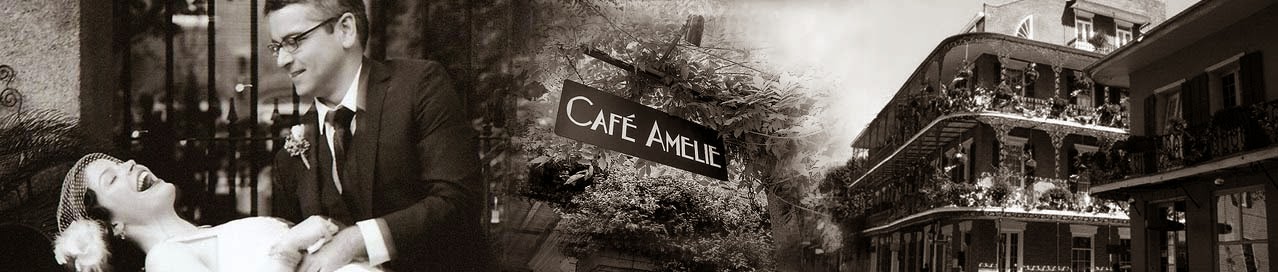
Café Amélie and the 7th Duchess of Richelieu

Café Amélie, 900 Royal Street, New Orleans, USA


A chum of the old Abbé HP has had the opportunity to visit the city of New Orleans.

So what is the connection with the cité idéale, here in Poitou?

The 7th duke of Richelieu (and Fronsac) married the American heiress, Alice Heine. She gave a son and a daughter to this older husband in their five short years of marriage. She herself was the daughter of Michel Heine, head of the Berlin/Paris/New Orleans bankers Heine & Cie. Michel reconstituted the ducal domaine around the château de Richelieu as a flamboyant wedding gift, after the property's fragmentation following the defeat of the little Corsican at Waterloo in 1815.  The 5th Duke had escaped from the 1789 Revolution by going to Russia, and the family estate had been sold and divided.

The park one sees today in Richelieu is really the result of this spectacular gift, re-designed by the well known 19th century landscape designers, the Buehler Brothers.

This rich and glamourous belle of New Orleans was the daughter of Michel and Amélie Miltenburger, a daughter of a prosperous New Orleans family of architects. They had a string of houses on Rue Royale in the French Quarter centered on street number 900.

Today this connection with France and Monaco is well remembered in this partly Francophone city.  The Milterburger houses are still there, redolent of the grand mansions of New Orleans, and Alice's birth house is now a popular restaurant called Café Amélie, named after Alice's mother.


Abbé Henri's souvenir tee-shirt; 25$!


Friday, 27 March 2015

Charleville - another Cité Idéale comes to Richelieu

4 pm, Saturday 18th April 2015

at the townhall
37120 Richelieu

Click on the image for more details


***

Thursday, 5 March 2015

The Endowment Fund and the so-called 'Tour Sainte Anne'

The restoration of the 'tour à l'angle' has become the official second project of the Fonds de Dotation - the Endowment Fund - of the town of Richelieu. 

The 1635 building is already owned by the town and the necessary permissions are being sought from the relevant conservation authorities. 

The new project will follow the completion of the Fund's first project, the restoration of the gates of the Porte de Chinon.


The 'Tour à l'angle'


***

Wednesday, 4 March 2015

The current bedtime reading of Abbé Henri

He has started to read this text book to understand the development of Hapsburg Spain the the era of the cardinal duke.
As the old political maxim says:
'Know the enemy better than he knows himself.'
Spain was the superpower of the 17th century, but was finally checked by the cunning long-term power-politics of Armand-Jean whose FRANCE finally came to question this Hispanic supremacy in the reign of the young sun-king Louis XIV, following Richelieu's own death in 1642.

While the palace and cité idéale of Richelieu were being created, the First Minister of France duelled with his opposite number in Madrid 
the 'conde-duque' Olivares,
Minister to his master, Felipe IV, King of Spain.

a detail from 'The surrender of Breda' by Diego Velázquez

Felipe IV,  King of Spain
Velázquez
Don Gaspar de Guzmán y Pimentel Ribera y Velasco de Tovar
the Count of Olivares
and Duke of San Lúcar la Mayor
Velázquez

***

Tuesday, 17 February 2015

The town hall authorises demolitions of structures in the moat.

The northern pavilion of the Porte de Loudun, and site of the former building

Richelieu is a rectangular walled city, with a basically complete moat running on three sides and the river Mable - suitably widened - on the fourth, the eastern, side.  Over the many years since the town's foundation in the 1630s, the owners of houses built on the inside face of the town's girdling walls have sometimes taken the opportunity to 'annexe' the part of the drained-out moat that is in front of their particular property.  Windows have been broken through the originally windowless town walls to receive light, and sometimes whole buildings have been constructed on this 'no-man's land' of - les douves - the moat. Gardens and fertile vegetable plots have been well tended. The individual owners do not own title to the 'annexed' land, except by dint of long occupation.

As the town is so unusual, the national architectural stewards of the town's heritage, Bâtiments de France, have long taken the view that these 'illegal' structures should, where practicable, be removed.   Their objective is to return the external appearance of the town to its original manner. This is obviously a long term objective, but this policy can only be triggered when an application for any change is submitted to the authorities.  

As a result of this severe policy, the properties involved may have a troublesome 'blot on title' and they have often fallen into dereliction as a result, as they cannot easily be sold on to new owners.  

Some would say that the 'rich palimpsest of history' has a delightful picturesque of its own, and that the several owners involved have lavished much attention on their gardens and allotments, which trouble no-one.

In addition many of the perimeter buildings 'intermuros' have raised the height of the original town walls to allow an additional third storey to be added to their own particular property.

A view north along the now unobstructed moat

Next to the Porte de Loudun, on the western side, there WAS a large 3-storey extension sticking boldly into the moat area.  It was attached to a derelict property within the walls, and no one was looking after its condition, as the buildings' s owners must have died out.  Recently, the failing roof and gutters were causing the endwall to become unstable as the old structure, drenched every time it rained, got much weaker and cascaded masonry into the moat in a spectacular and dangerous way.

The 'gaping wound', where the old extension was located

The Town of Richelieu itself has taken charge and the old building has now been demolished, as can be seen here in the photos.  This new state will allow someone to purchase the remaining buildings next to the Porte de Loudun and restore them in an appropriate way.  It is hard not to be impressed that the Mairie has acted in such a decisive way, and we all look forward to the rebuilding of the inner structure to the exacting standards of Mme. Bartelémy, Bâtiments de France and the DRAC.

South along the moat.
the condition in May 2015

***

Monday, 16 February 2015

Two new enterprises start in the cité idéale

 The new make-up and pampering emporium L'instant détente - the instant relaxation
 Replacing the former bicycle and moped shop - latterly an art gallery - is a new shop selling beauty products and services to the gentlefolk of the pays de Richelieu.  Why not 'pop-in' on market day?

***
'Le Chinon' plancha and tapas bar

François Rabelais is an inspiration for drinkers and diners alike!
The agéd Café des Sports has been re-branded as a plancha and tapas grill bar.  Let us hope that the seedy former clientèle has been re-branded too!
(The old Abbé HP was quite fond of the old piebald dog who faithfully patrolled the façade of the Café des Sports.  He wonders what has become of him….?)

***

The crazy tree

Guardian of the town's Porte de Châtellerault
So mesmerised by the axial layout of Monsieur Lemercier, architecte du roi,
that Mother Nature has ensured that the tree's branches and foliage GET ON AXIS!
Three hundred and eighty years later!
Such are the rigours of geometry.

***

Thursday, 15 January 2015

Henri P's new friend in Madrid - Chantal


Inspired by this blog above, the old Abbé Henri Proust has made a short trip to the National Gallery in London to post about all those lovely canvases on subjects close to the passions of his new friend Chantal.
Chantal herself  is actually a daughter of the Cité Ideale and has taken her native affection for the seventeenth century to the city that was never far from the political concerns of Armand-Jean himself,
MADRID.
the Hapsburg coat-of-arms

Maybe she can find some imagery of cardinal duc's opposite number in Madrid
 in the court of Phillip IV, The Count of Olivares…..'el conde-duque'

Olivares by Velázquez

***

Meanwhile three royal courts; three court painters


Triple portrait produced for the Roman sculptor Bernini to inform the making of his marble bust of Armand Jean


by son-in-law Juan Bautista Martínez del Mazo


"…..his eyes follow you round the room."

(Both boys were later killed in the English civil war, on the Royalist side)


An unusual un-faded canvas by Poussin showing his original coloration